Interview: Adopting a child when you are CF and single
Pierre-Alexandre Tremblay shares his inspiring journey as a single man living with cystic fibrosis, lung transplant recipient, who chose adoption as a path to parenthood and testifies to the challenges, emotions and learnings related to this life project.
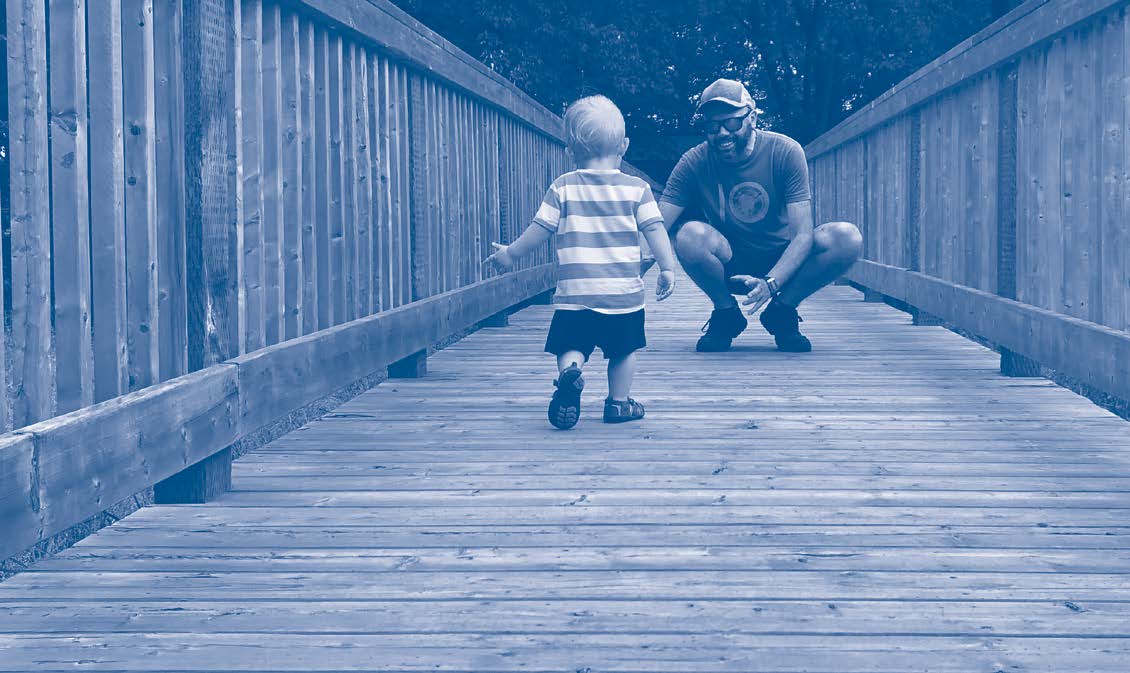
1. Hello Pierre-Alexandre, can you introduce yourself?
I was born in Saguenay and moved to Mauricie at the age of 12. I was diagnosed with cystic fibrosis at 3 months. I have been transplanted for almost 18 years and I am already 40 years old. The years go by so quickly! I studied accounting in Montreal and that's when I received my lung transplant. After my studies, I went back to live in Mauricie and I have been working full time ever since. I have always had jobs that I liked, so for me going to work is beneficial. I like to have the feeling of achieving myself while having fun and I am lucky to have a job that allows me to do so! Since I started working, I have a preference for management and people. Since I like challenges, after 12 years as CFO, I changed jobs to HR Director. I love working in Mauricie because I can also easily enjoy the outdoors. Whenever I have free time, I spend my time playing outside and doing activities such as mountain biking and kayaking in the summer, and skiing and snowshoeing in the winter.
2. You are currently in the process of adoption, how did you come to this decision?
I have always known that I will not have children naturally due to infertility due to cystic fibrosis. So over time, I learned about the options available to me. It was by reading the articles in the publications of Living with Cystic Fibrosis, participating in conferences, and talking to people with CF on this subject that my thinking evolved. For me, the option of adoption came by itself. It was by separating at 38 and still having the desire to be a parent that adoption proved to be the best option. I did not have time to meet a spouse and get to know her in order to have a child together with the deadlines of in vitro fertilization. My urgency to live was imposed. As I knew that I did not have to wait many more years to make my dream come true, I started the adoption project alone via the DPJ.
3. Where does your desire for parenthood come from?
I have always loved kids. I am a person who is passionate about human development and relationships between people. For a long time I wanted to have a child. I had the happiness of being in the life of an adorable little man, the son of my ex-spouse. It was by living with this little boy on a daily basis and watching him evolve that I was 100% convinced that this was my purpose in life, my reason for being, which is to take care of a child.
4. How did your approach and the adoption process go?
Once you have made the decision that this is what you want in life, you want it to happen quickly! But patience is needed, as the process is long. The whole process took a year and a half. OK I know that many couples try for several months before declaring victory and that the pregnancy is nine months, but I thought it was long! In all of this journey, what I have learned the most so far is to let go and accept that I am not in control.
I opted for adoption in Quebec with the DPJ. The program is called “Mixed Bank.” So you are a host family to start with. You have no rights over the child. For the system, you are a paid resource to take care of a child in the system. It's cold when I say it, but sometimes that's how I feel. The interveners are exceptional, they are dedicated to the good of the child while dealing with the limits of the Act. My hat is off to them. The other type of so-called regular foster families must have a vocation and a certain detachment from the limitations of the system. I am full of admiration for these people who have been taking in children for so many years.
The adoption process is very thorough. When I decided in December 2019, I contacted the youth center in my region to find out about the process. It is at this point that you realize that you are entering a “process.” I thought I'd get all my answers by talking to someone. And no! Two information sessions are required. Then, if you fit within the criteria they appointed you and still want to start the process despite the warnings, you must make the formal request in writing. Then you get two huge forms with over 50 pages in total. But the objective is to know you well, which in my opinion is essential. You should give your financial statement and references to contact. And now you are waiting for all the references to be taken. And one day you receive a call telling you that your evaluation can begin. In my case, it was six meetings where we discussed my life, who I am, my childhood, my romantic relationships, my parenting abilities, etc. They came to the house to make sure everything was in order. Then, a committee must approve your application. Normally, once you get approved things go quickly! I was offered a child three weeks later. I accept, I get ready, I buy the clothes, I make sure that nothing is missing in the room according to the age of the child I am going to receive. But a judge must agree to the placement of this child. So I am waiting for the call from the intervener to tell me that it is OK and that she is coming with the child... But no, they are telling me that they have run out of time and that the case has been postponed... for two months to be able to finish presenting the evidence and testimony. Since it can be very long and there may be additional delays at the court, I therefore made the decision to move on to another project — that's how they call a child in foster care, a project. Then, I am presented with another project which, on the other hand, presents a higher risk of returning with the biological family. A risk that I am not comfortable with, because my plan is to adopt a child. I am not in the “regular host family” category. Finally, I was called back to present the ideal project for me: a 3 and a half month old child. I agree and I am impatiently waiting for the date of the court that will authorize the arrival of my coconut. The big day was in April 2020. A day that I will remember in every detail. It is the workers from the DPJ who bring my coconut to me. I am waiting impatiently for his arrival. I look out the window every two minutes to see if there isn't a car coming in the driveway. Finally they are coming! Joy and stress take over me. A whole moment rich in emotions. The joy of finally making my biggest dream come true. It is a very special moment. We spend time together getting to know each other. The following days were magical. It was all new for both of us. Him, his environment, his new parent, new sounds, new smells. For me, I discover his temperament, his personality, his sounds (especially during the night), what makes him laugh. We have now been together for a year and a half. Every day, I am amazed to see it evolve. I have never regretted my choice to embark on this crazy project. It gives me so much and it teaches me how to live in the moment. I always wanted to live my life to 110%, to be like “normal” people, to disregard the constraints of my illness. My coconut taught me to slow down and to accept things as they are. This is not always easy, as the adoption process is far from over. I am still in the foster family stage. I am looking forward to the court date for the next steps.
5. How is cystic fibrosis a barrier or could it have been a barrier?
The DPJ asked me about this to understand the impacts of CF and especially of life after the transplant. My doctor at the transplant clinic had to fill out a medical questionnaire. He said that the prognosis is excellent and that he sees no imminent risks. Certainly, in embarking on this process, I was worried that my illness would be a barrier. This was not the case at all, on the contrary, I consider that I have great values to transmit with the experience of this disease.
6. Since cystic fibrosis is a disease that unfortunately cannot be cured, how do you look at your own death in relation to your role as a parent? Is that something you thought about a lot?
I thought a lot about this aspect. I have discussed this with my doctor and he considers my health to be very stable. So, I hope to be able to live with my coconut for a long time. All my life I have been wondering about the moment of my death and it is normal to do so. That's why I have an agreement with my sister: if something happened to me, she would take my coconut. And in the end, I tell myself that the love I gave him will follow him for the rest of his life!
7. How did you manage daily life alone (and especially the nights) with an infant where you had to create a cocoon with him without relying on outside help during the first months?
With a 3 and a half month old child, it is recommended to start a “cocoon” period with a child who has just been adopted to create an attachment bond. To get there, we had to isolate ourselves and spend our time together. The child must understand at their own pace that I am their new parent. That is why you should avoid seeing other people so that he can understand that I am the one who will meet all his needs. For us, this period lasted for two months. A friend said to me, “What are two months in a lifetime? Do you remember waiting for a transplant that lasted 2 years? You went through it so you will be able to get through that too! ” I was also lucky, because I had the “cocoon” period at the start of COVID-19 when everyone was confined to their homes. So, I did not envy my friends who went out because they were also taken home just like me!
For sleepers, I am privileged to have an easy baby. He never takes long to fall asleep and he has never cried for long. The best thing I did was nap at the same time as him. It's a good thing that a lot of parents gave me.
For other daily tasks, I find things for myself and make choices. So I use a catering service for meals, I have a person who comes for cleaning, mowing the grass and removing snow. For the rest, I have always aimed to minimize tasks, which is very useful for me in this solo parenting project.
My motto is to keep it simple!
You also need a good network. My friends and my mom were very present. My friends give me the advice and support I need. My mom often keeps my coconut, especially when I went back to work after my 37-week parental leave. With the shortage of labour and an increase in births, there is a shortage of child care spaces and I did not have access to this service for the first seven months of my return to work. I have an excellent employer who is very understanding and accommodating in my project. It allowed me to work four days a week and to telecommute when needed. So my mom kept my coconut a lot, a lot during this time. Now that my child has a place in daycare, life is easier and my mom is less tired! I continue to work 4 days a week because I like this pace, it allows me to spend more time with my little man.
8. How do you conceive of a romantic encounter as a single parent?
For me, meeting someone is not an ultimate goal in the life stage I am currently in. The person I meet must be wonderful. I will not let the first come into my boy's life. It is important for me to have the same values with the person who shares my life and that of my little man. I know that life will present this person to me when the time comes. I never feared single life.
When I meet my lover, a new dynamic will be created with my coconut. The fact that my little man does not have a mom, this person will play a very important role and I think it is essential to give him the place she wants. Do not force things and life will bring us the happiness we want.
9. How do you see the future?
I live from day to day. Having a child is so much about being in the moment that I have no choice but to live it that way. Anyway, I've learned that making plans with a child is useless, because they can really change often! Life will dictate what comes next for me.
10. Do you have advice or resources that could help others who have the same desire?
The best advice I can give is to talk about it and be well informed. It is not a decision that is taken quickly, it must be matured. This is why I recommend talking about it a lot, because it allows you to change your thinking and validate your desire. Don't be shy about communicating with the right resources. For those who want to adopt a child with the DPJ, I recommend that they contact the youth center in their region.
11. Do you want to add anything?
There is no shame in wanting to make your dreams come true, you have to go for it!
Interviewed by Sébastien Puli in September 2021
Interviews and testimonies
Les saines habitudes de vie avec la fibrose kystique: trouver un équilibre réaliste au quotidien
À 25 ans, Lex partage comment elle apprend à écouter son corps, à gérer son énergie et à trouver son propre équilibre avec la fibrose kystique, sans laisser la maladie définir qui elle est.
.jpg)
Aimer la vie et apprendre à la donner
Atteinte de fibrose kystique, Audrey refuse de se laisser définir par la maladie. Entre le deuil de son père, son combat pour la santé et son nouveau rôle de maman, découvrez le portrait d’une femme qui transforme chaque tempête en arc-en-ciel.