Animal therapy to promote well-being
Animal therapy uses animals to improve people's emotional and social well-being.
Article by Élisa Baldet, zootherapist, coordinator atIZQI (Institut de zooérapie du Québec-international) and founder of SOS Libellule
August 2021
Animal therapy, i.e. the use of animal mediators for vulnerable people or people with special needs, is an alternative approach complementary to traditional health care, which aims to improve the quality of life. According toInstitut de zootherapy du Québec-International (IZQI), it refers to all the beneficial effects of animals on human health.
For the American Veterinary Medical Association (AVMA), animal therapy represents a general term now commonly used to describe the use of various animal species (dog, cat, rabbit, guinea pig, bird, horse, or other) and in various beneficial ways (therapy, education, activities) for humans. In such approaches, these animals are an integral part of the treatment process, which aims to improve the physical, social, emotional and cognitive functions of the beneficiaries. However, pet therapy as an approach used in the field of medicine is relatively new. The origins of animal therapy come from many disciplines throughout the ages: psychology, sociology, psychiatry, and later veterinary medicine.
A bit of history
The human-animal bond created for therapeutic purposes began to emerge in the 18th century thanks to William Tuke, director of York Retreat in England, a shelter for people with mental health needs. He was the first, with his grandson Samuel Tuke, to document the use of animals with patients in order to improve their stay. Encouraged to take care of animals (rabbits, seagulls, falcons, and poultry), patients sometimes managed to arouse social and caring feelings.
In 1867, a center specializing in the treatment of epilepsy in Bielefeld, Germany, recognizing the benefits of animals for humans, added pets to its therapeutic team. In the 1930s, Sigmund Freud himself believed that dogs had a special sense that allowed them to judge a person's character accurately, like an emotional barometer. Her chowchow, Jo-Fi, attended all of her therapy sessions.
In the United States, in 1944, the Army Air Force Convalescent Hospital in Pawling, New York, encouraged the contact of soldiers treated for post-traumatic stress disorder with farm animals (horses, chickens, cows).
The concept of “pet therapy”, or zootherapy, was truly born in the 1960s, with the research of Dr. Boris Levinson, an American child psychiatrist, which resulted in Pet Facilitated Psychotherapy. He was the first clinician to officially present and document how pets could accelerate the development of a relationship between therapist and patient, thus increasing the likelihood of patient motivation.
It all started when an autistic, nonverbal, inward child started talking and interacting with Levinson's dog, Jingles, while the boy had been left alone for a few minutes. This was a significant event, as Levinson had not been able to get the child to speak during the previous sessions. He thus found that animals functioned as transitional objects with which patients could relate: the animal (transitional object) comes to reassure the patient, comfort him, defend him against anxiety, thanks to the existence of an attachment bond created between man and animal. The animal is by no means a therapist, but a wonderful mediator, because it acts as a social catalyst: it facilitates interactions between individuals.
Since then, other researchers, therapists, veterinarians, doctors, teachers have experimented with the human-animal bond and recognized that it is relevant in the treatment of patients, the follow-up of students, children, adults and the elderly with needs for physical and emotional healing.
American journalist, columnist, and book author, Gina Spadafori, believes that mediator dogs have the ability to reach people at a level that offers real emotional support. “They are therapy dogs, and anyone who has ever seen them in action cannot doubt the difference they make,” she wrote in her article Cold Nose, Warm Hearts — Therapy Dogs Offer Unconditional Love to Those Who Need It Most (Cox News Service, Aug. 30, 2004).
In Quebec, several health institutions have opted for animal therapy: the Douglas Mental Health University Institute was a pioneer in the field, integrating such a service in 1985; in 1993, theInstitut de zootherapy du Québec-International (IZQI) has set up an entire department of animal therapy on the premises of Jeffery Hale Hospital; the Rivière-des-Prairies Hospital, since 1993; the Laval University Hospital Center (CHUL) and the Soleil Mother Child Center in Quebec, since 2000; the Quebec Centre for Health and Social Services, since 2000; the Quebec North Health and Social Services Center; the Philippe Pinel Institute in Montreal, since 2002, etc.
The benefits of animal therapy
Promoting a multidisciplinary approach, animal therapy can be done in conjunction with various other therapeutic approaches at the recipient's home or in a specialized health center. It also fits very well in educational institutions.
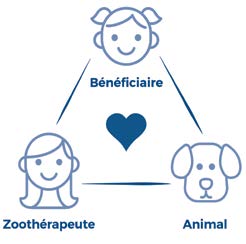
action on synergy
triangular that unites the
patient, the intervener
zootherapist and
the animal. © SOS Libellule
The role of the animal, carefully selected and trained, is to facilitate the helping relationship, to secure and to motivate the beneficiary. The animal is a real working partner for the zootherapist and allows the eyes of the person he meets to shine!
Guylaine Normandeau, founding president ofIZQI, one of the pioneers in Quebec offering animal therapy services and training future animal therapists, maintains that “animal therapy gives significant results because it is based on fundamental values and highlights what is best in each of us. This therapeutic approach makes it possible to observe and listen to people in order to better understand the difficulties experienced in their environment, in order to provide them with sincere help.”
Chez SOS Libellule, language and animal therapy clinic, we welcome children with language development disorders (LDD), attention deficit disorders (ADD/HD), learning difficulties or other challenges. Animals are an integral part of the ways children are motivated, focused, and confident. Pogo the Samoyed, Luna the Shih Tzu, Kiwi the rabbit, Mini-Rex and Dela the turtledove are present at each session and make children happy!
SOS Libellule also offers mobile pet therapy services for people in emotional distress or facing mental health problems, at home, in youth centers, adult housing centers, retirement homes and schools. Élisa Baldet, zootherapist, language stimulation agent and founder of the clinic, makes the following observation:
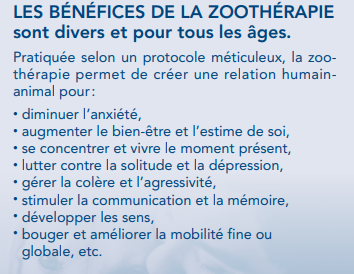
“Animal therapy is a great approach to contact and communicate with people experiencing great loneliness, whether social or psychological. They are people suffering from loss of autonomy, cognitive loss, or dementia; or children and young people with episodes of anger or violence; or the non-verbal or those with selective mutism. Thanks to adapted assistance and communication techniques, the zootherapist introduces the right animal to the beneficiary and begins the creation of a relationship based on trust and without judgment in order to appease, stabilize or improve the person's condition. For its part, the animal promotes a certain bond of attachment.”
Concretely, animal therapy can take several forms. The animal can be present during consultations, emergency interventions, wellness visits (individual or group; at home, in residences or specialized centers), animafitness sessions (physical exercises accompanied by the animal), educational workshops (animal discovery, animal education, animal education, animal education, bite prevention, etc.), desensitization (to overcome fear or phobia of animals), as well as advisory services to coordinate the installation of one or more animals at the beneficiary's home or specialized establishment. Interventions pursue specific goals, set in collaboration with health, social services or education professionals and the family.
Today, more than 3 million dogs and cats live in households in Quebec. So pets are very much appreciated. And when the latter, educated by zootherapists, help others, they are adored and even work miracles!
Source: https://irp.cdn-website.com/bcd9cc87/files/uploaded/Zootherapie_mai2021.pdf
Psychology

CFTR modulators and mental health
This article takes stock of the possible links between CFTR modulators, in particular Trikafta, and mental health, by exploring indirect psychological effects, possible biological mechanisms, drug interactions, and the importance of individualized follow-up.