The story, step by step, of the rise of Marc-Antoine Pelège, athlete and CF osteopath
The inspiring story of Marc-Antoine Pelège, an athlete and osteopath living with cystic fibrosis, who tells the story of his ascent of Kilimanjaro step by step as a symbol of overcoming, resilience and hope for the entire CF community.
Written by Marc-Antoine Pelège
Edited by Roger Clavet
Thrive, a publication by Vivre — Fall 2024

When CF means to cross Mount Kilimanjaro
Day 1 — Monday September 2nd
We start the first day of climbing Kilimanjaro with a 7 km course, leaving at 15:00 via the Rongai approach route. At an initial altitude of 1,500 meters, this stage took us up to 2,750 meters. At this altitude, our team of 11 people was waiting for us, the tents already set up and a hot meal ready to be served.
Each porter, with a well-defined role, makes the ascent more accessible by carrying our luggage, food, tents, and equipment to heat meals. Two guides also supervise our group and will accompany us for the” Summit Push ” final of 6 km, scheduled for the night of the third to fourth day.
The air is getting drier, the euphoria is rising
Day 2 — Tuesday September 3
On the second day, we go from 2,750 to 3,780 meters. Breathing becomes a bit more difficult, and you really feel the lack of air. You should know that at this altitude, only 65% of the available oxygen is left. Each step is an effort, and I'm starting to feel a slight euphoria, a pretty fun feeling, like a little” High ” due to the altitude. With my spouse, we laugh out loud at the slightest joke, no matter how funny it may be. In short, no need for drugs, altitude is enough! We completed this 11 km course in five hours.
Day 3 and Ascension Night — Wednesday September 4 and Thursday September 5
The third day promises to be more and more demanding. With a positive altitude difference of 900 meters over seven kilometers, we go from 3,780 to 4,720 meters above sea level, just 87 meters less than Mont Blanc, the highest peak in Europe, which peaks at 4,807 meters.
When we arrived at the camp, food and the warmth of a hot water bottle were waiting for us. It was 2:30pm. After an hour of rest, the guides briefed us on the progress of the final ascent, the” Summit Push ”. We will wake up at 11 pm, ready for a midnight departure, after a small coffee, a few cookies and Popcorn. We had dinner around 5.30 pm, and went to bed at 6.30 pm, already nightfall. Exhausted, but with slight stress for the night to come. You should know that the nights are cold, around 4 degrees. We were well covered: sleeping bag, merino jacket, down pants, and hat to keep out the cold.
23:00 sounds. It's time to get up. Coffee, cookies, popcorn. Then you have to get dressed... But how? It is cold, but we are going to move to climb this “small mound” of more than 5,800 meters! I decided to put on cotton pants and put on four layers on my upper body: merino wool, down and cotton. Gore-Tex to protect myself from wind and potential rain. I tell myself that with the movement, I shouldn't be cold... Mistake!

The cold is gaining ground
Within the first few minutes, I realized that the pace was extremely slow: one or two kilometers per hour, step after step. After an hour of walking in the dark, headlamp on, and facing a steep drop, I approach the guide to ask him to speed up a bit. I am cold, and so is my partner, despite our many layers of clothing. The guide speeds up briefly and then slows down again. My body is shaking, and I try to warm myself up by taking a deep breath, moving my arms, and taking quick steps. But nothing helps.
I then remember that I had another pair of pants and an extra pair of socks in my bag. We stop to get more warmly dressed. Two porters and our guides are helping us, and I notice that they don't even have gloves, yet they seem perfectly at ease in this penetrating cold... The extra clothes make us more comfortable, but breathing is becoming more and more difficult. At 5,000 m, I feel intense pressure in my chest, accompanied by hyperventilation. The anxiety attack is on the rise. I ask myself, even for a split second: “But what am I doing here? ”.
It's raining tears
Fortunately, I remember my meditation and mindfulness sessions, where we learn that slow breathing calms the nervous system. “I am not the anxiety,” I repeat to myself. I focus on five slow breaths, and then tears start to flow down my cheeks. I cry while walking, without really understanding what is going on inside me. Gradually, I feel better, the pressure in my body decreases.
The ascent continues. The sky is still full of stars. When I raise my head, my headlamp still doesn't light up any visible peaks. We move at a snail's pace, in silence, in the dark, with breaks of five minutes to drink and eat a little. Then, I notice a slight glow to my right, a changing hue in the dark. At the same time, the guide announces: “A few more meters.” And indeed, 50 meters further on, we reach the first peak — Gilmans Point — at 5,685 meters.
Again, tears are coming out. Soon we will be there. Each step requires a breath. The climb is slow, almost painful. It's a very particular sensation: you want to move forward, but the body says “no.” Finally, we reach the first of the three summits. Yes, because when we think that the effort is over, there are still two kilometers and 200 meters of altitude difference left, which will take us an hour and a half more to get to the Uhuru Peak.

At the top, a breath of fresh air
I thought I had already experienced the hardest, but the last 500 meters were the hardest. I staggered as if I had drunk a bottle of vodka—pure confabulation—dragging my feet, stopping every 50 meters to catch my breath. Finally, we get there, at the summit of Africa: Kilimanjaro, at an altitude of 5,895 meters.
Strangely, once at the top, the body acclimatizes quite quickly, and it is possible to move a little faster (but not too much). A smile is emerging, accompanied by new tears of joy. We enjoy the view above the clouds, a rarity. It's not every day that you look at life from this perspective!
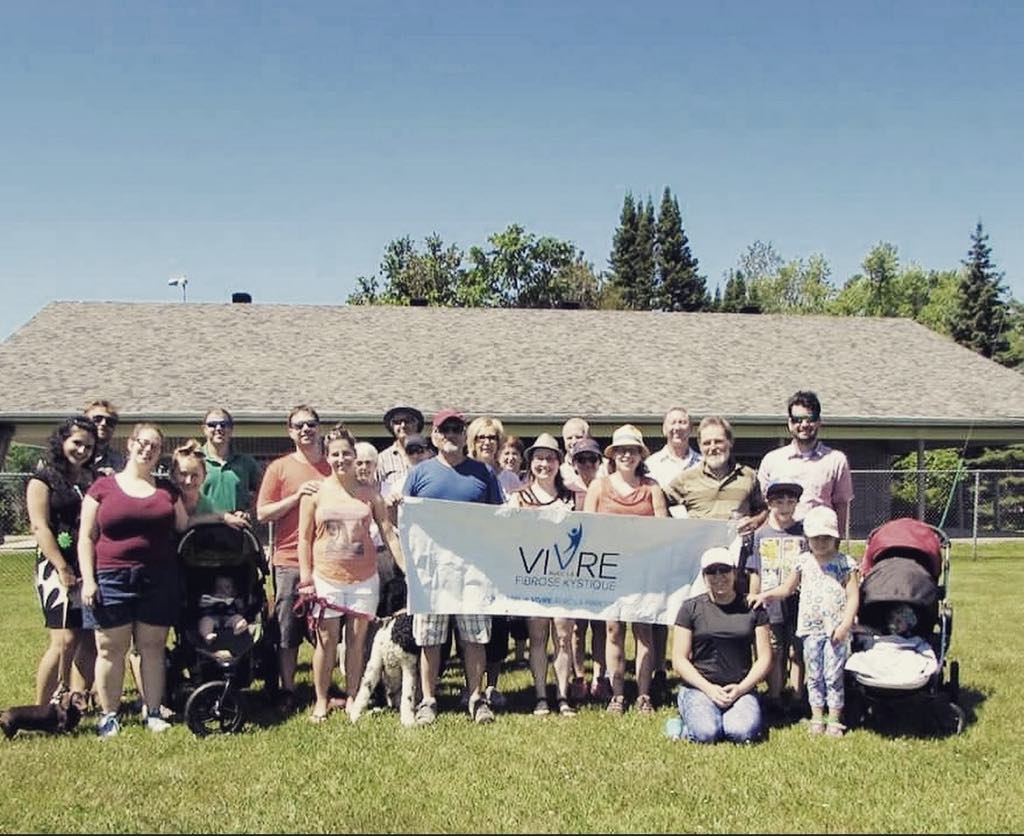
I am proud to raise the flag of Living with cystic fibrosis and take a deep breath of fresh air, for all those who won't be able to come here. And for the others, who have the desire and the desire to venture there, I leave a few oxygen molecules here at the top.

“The objective of the Kilimanjaro Expedition is to show that you can always surpass yourself. Theoretically, illness often brings us down. The mountain, on the other hand, pushes us up. There is no limit to climb. Because going up is difficult, but going down is very easy.” — Marc-Antoine Pelège
Athlete, dancer, entrepreneur and osteopath of French and Canadian nationality, Marc-Antoine Pelège lives with cystic fibrosis. At the age of 36, at the beginning of September 2024, he succeeded in an unusual feat: crossing Kilimanjaro, the highest peak in Africa at an altitude of 5,895 meters, to proudly raise the flag of Living with cystic fibrosis.