Testimonial: What if the disease had something to teach me...
A testimony on cystic fibrosis, overwork, work stoppage and lung transplantation, between the quest for performance and the redefinition of oneself.
I was six months old when the diagnosis was made. At the beginning of the 1980s, the prognosis for the future of affected children was not very encouraging. Despite everything, my parents decided to brush their nose at reality. That is to say, they will do everything they can to have a healthy cystic fibrosis child.
The disease is a part of me without defining myself. Basically, at least in the eyes of my parents, I am still a child like any other with a range of possibilities, skills to develop and, above all, a future to build. Although I don't hate life or illness, I still feel a strong inferiority complex compared to healthy people. This impression encourages me to go further to prove to myself and others that despite my disability I am a respectable person who has something to contribute to society. Coming from a family where performance and self-realization are valued and encouraged, the apple did not fall far from the tree. I run on that same fuel. I like to live in action. Living day by day, too little for me. The projects, the challenges and especially the results nourish me.
Despite the illness, anything is possible, by planning a plan A, B and sometimes C. I manage to get a scholarship to study at a major university in Paris, travel to remote places via Russia, Uruguay, Greenland and the Galapagos, to name a few, to name a few, to name a few, to walk the 170 kilometers with significant differences in altitude around Mont-Blanc (one of my greatest prides), to walk to across Europe alone with my backpack, having a lover and a nice group of friends. Undoubtedly, life was good for me. For a long time, I took my health for granted and believed that I had the ability to control the disease. Statistics are for others. As for me, I'm going to smash them!
Around the age of twenty-one, when I was finishing my final year of bachelor's degree in economics at Concordia University in a Co-op program, things changed for the first time. In the past, I have experienced hospitalizations, but never such a rapid and important decompensation.
As I successfully juggle studies, work, and life as a couple, things take an unexpected turn. In a few weeks, my lung functions increased from 113% to 37%. Literally, I see stars. I count my steps between my trips. Diagnosis: Overwork.
Obviously, this results in a long hospital stay. Fortunately, my duties went back to 94% and life got back on track.
Without knowing it yet, the disease has just woken up and I am embarked on a roller coaster of illness. With my bachelor's degree in hand, I started my master's degree in Economic Science and completed it fourteen months later by collecting sleepless nights studying and infections. While I always aim for performance, I obviously didn't understand anything. Before I even put the last point on my master's report, a state corporation, where I did several internships during my studies, offers me a job in my field. I am more than thrilled to be offered such an opportunity. My work values me, gives me status and a comfortable financial health. With work, the daily routine is established at a glance. Between the treatments, the clapping that I had to resume, the exercise, the work and the traffic, I have very little free time left. Most weekends, I spend them sleeping to regain my strength and dreaming about my next trips.
Even though I have a very strict lifestyle and follow the treatments to the letter, the disease continues to make its way and my respiratory function is reduced by about ten percent per year. Looking back, the smartest thing would probably have been to reduce my workload. At the time, I didn't make it an option. If healthy people are able to work full time, so am I.
No matter how hard I cough, spit, and vomit my life every morning, I go to the office. I have undoubtedly expanded the meaning of the lyrics of the song by Henri Salvador saying that work is health. Maybe, but at what cost? Then, I do a first pneumothorax requiring pleural talcage. Before leaving the hospital, the surgeon said a sentence that shook me. “Annie, I can't say if it will be in two years, five years or ten, but one day you will be a good candidate for the transplant. Don't forget to come see me before it's too late.” I get the advice like a slap in the face. I am not ready to make that an option. In my opinion, my difficulties are still temporary. My lungs are going to go up. It can only be otherwise. Then things seem to want to calm down for a while. I feel like I'm in control again.
The calm before the storm
At the beginning of 2009, I had a nose dive. I like to think that it was the beauty of the Prague Christmas trees that took my breath away. On the flight home, I know it will be my last trip for a long time. My body is no longer keeping up, my lungs even less so. I urgently go to the hospital to treat pneumonia. Upon admission, my first call goes to my boss to tell him that I have to be away for two weeks for treatments. I make it a priority to get back to work quickly.
After three weeks of treatment, my functions did not rise much higher than a poor 31%. Although I have seen it coming for some time, the reality is striking me head-on. Lung transplantation is now becoming a reality. At the rate at which my duties are declining, it makes me wonder if I will be able to last the estimated two years of waiting until the call. At the foot of the wall, I had no choice but to reassess my priorities. Am I still preferring a job to the detriment of my health? I love life too much not to give myself a chance. I have to follow the advice of my doctors.
This is how I end up on sick leave. For a moment, I feel like the sky has fallen on my head. I am losing my bearings, my status, and especially my identity. Outside of work and travel, who am I? What defines and turns me on? I don't have the faintest idea. Even with my name on the transplant list, I am still hopeful that the tide will change and that I will be able to postpone the surgery for a few more years.
In the meantime, it's out of the question for me to waste my days watching TV on my couch and envying everyone in good health around me. Since I am forced to take a break, I might as well use this time wisely to find out what I really want out of life. Ruminating on my disabilities is too heavy for me. I prefer to focus on what is still possible for me. Drastically moving from an action mode to a mode of contemplation is not always easy or even natural for me. Equipped with my oxygen tank, I started yoga and the Pilates method with groups for retirees. The benefits were felt both physically and mentally. To occupy my time, my sweet tooth takes me to pastry classes. My desserts are fabulous to the eye, more or less to the taste. I try painting, Russian and photo classes. The interest is there, but my little inner flame does not seem to quite vibrate. Then one fine summer morning, the postman leaves an advertisement in my mailbox announcing the evening courses offered at the National School of Comedy. I take it as a sign. In addition to learning the basics of writing a good joke, evenings at school serve as an escape from daily life. Laughter is becoming my therapy. As a revelation, I discovered a certain talent for storytelling and a particular interest in writing. This is how I let myself be tempted by writing a first novel. Behind my keyboard, I feel vibrating like I haven't felt in a long time. In addition to entertaining me, writing nourishes my need for valorization and is very well practiced during the endless aerosol and intravenous treatments.
At the time of writing, I have been freshly transplanted for a few weeks. The wait will have lasted just over six years, so three years during which I was on continuous intravenous antibiotics. In addition to repeated superinfections, I had a major pneumothorax that almost compromised the transplant and hemoptysis requiring embolization. Although the wait will have brought its share of uncertainty, difficulty and moments of great anxiety, it will also be a great time to get back to basics. In addition to using this time to write and publish six novels that I loved every moment of creation, I redefined my priorities, cleaned up my personal care, and spent quality time with the people I love and who love me in all my simplicity for who I am and not for what I have to offer them.
All in all, if there are two things I want right now, it's to stay healthy to spend as much time as possible with my loved ones and not to let myself fall back into the whirlwind of performance at all costs.
Sometimes, humans have a short memory!
Interviews and testimonies
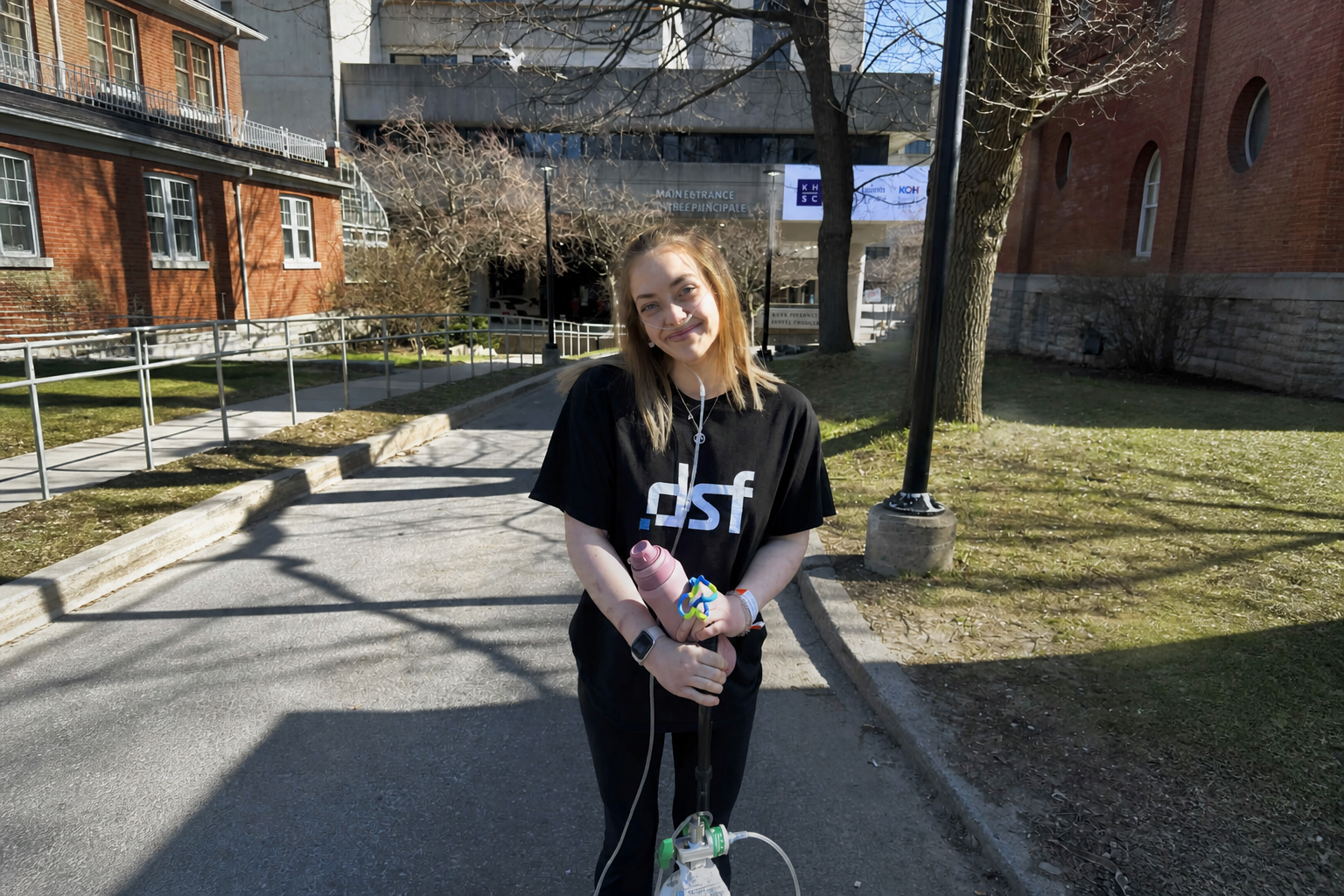
Les saines habitudes de vie avec la fibrose kystique: trouver un équilibre réaliste au quotidien
À 25 ans, Lex partage comment elle apprend à écouter son corps, à gérer son énergie et à trouver son propre équilibre avec la fibrose kystique, sans laisser la maladie définir qui elle est.
.jpg)
Aimer la vie et apprendre à la donner
Atteinte de fibrose kystique, Audrey refuse de se laisser définir par la maladie. Entre le deuil de son père, son combat pour la santé et son nouveau rôle de maman, découvrez le portrait d’une femme qui transforme chaque tempête en arc-en-ciel.