Testimonial: Life goes on
An intimate account of lung transplantation, interrupted adolescence, and the resumption of a “normal” life.
By Odile Lefrancois
Montreal (Quebec)
Seventeen years ago, a baby girl was born. It could have been any trivial story, but this one is not. Only two days old, the little girl had to be operated on because her digestive system was not working properly. The first clue in the eyes of the doctors, they had him perform some tests to confirm their first hypothesis and brought to his parents' ears a name that was then unknown to them: cystic fibrosis.
Today, years later, the small scar is still present on my stomach, among a few others. The one from my force-feeding cork, who artificially fed me for years. Those of my numerous infusions of antibiotics, which sprinkled my arms during my childhood. That of my old catheter, higher, when my veins were no longer sufficient for infusions. That of my bi-pulmonary transplant, when nothing else was enough.
I was 13 when my condition started to deteriorate. Despite my daily treatments, despite the countless vitamins, antibiotics, and others, despite regular visits to the cystic fibrosis clinic, I had to spend some time hospitalized at Sainte-Justine. I left less than a month later, reassured about my health.
Only a year passed between then and when I started sleeping with oxygen every night. For the first time, we were talking about bigger measures, more important than just medications. The word transplant was added to my vocabulary, and while I was always aware of the need to have this surgery one day, I did not expect it to happen so soon.
That same year, I only went to class for two months out of the ten months of high school three. Then, I had the invaluable help of a great university student, who kept me motivated in my studies even when I no longer saw the importance of it. I went to the hospital for at least half a day a week to make sure my condition didn't deteriorate too quickly. I saw a friend, who was also great, and the rest of the time I could only sleep, exhausted.
It's hard to realize how much energy it takes to breathe. At the end of my school year, I kept my oxygen all day long, completely dependent on these small O2 molecules. I never left him and, despite the help, I was still having trouble breathing. Between my long coughing fits and my moments of rest, only a short time passed and I was emptied at the slightest effort.
At the same time, my appetite was ruined by the huge amount of medication that was given to me every day when I needed more calories than ever. Thanks to a force-feeding device that I had already had since I was eleven, I was able to have access to greater nutritional value. In total, I was getting 4,000 calories each day, minus the calories I threw up. I still had to gain two kilos if I wanted to be accepted on the transplant waiting list.
My high school four just didn't happen. I took a few courses, tried to keep up to date, but I didn't have the energy left. I watched several series, which in turn consisted of several seasons. I also read a lot, lots of novels, but I quickly got tired. During the day, I did everything I could to get up as little as possible, and I would sometimes take a lot of naps without even bothering to go back to bed to fall asleep.
Around the beginning of December, I started using a new machine that helped me breathe better at night. That way, I could have a few hours every evening where I could really get some real rest. At first, I wasn't a big fan of this oversized mask, but I quickly accepted its presence. After a while, I was in a hurry to wear it, putting it on as soon as possible and always delaying taking it off.
I had to face the facts: breathing on my own was now a difficult task to do. At that time, my lungs were only functioning at less than 20%. It is impossible to know exactly how low I went since below this limit this measurement is no longer reliable enough to calculate lung capacity. However, I know that it has continued to get worse, even further down.
After the holidays, I was admitted to the hospital for the umpteenth time. This time my condition was deteriorating too rapidly, to a point where it was worrisome. Walking up the stairs, or just walking down the hall, everything exhausted me to an alarming degree. As someone who loved to read so much, I couldn't focus on one page for more than a few seconds. The words, the ideas, everything was mixed up in my head.
My body, little by little, became resistant to normal antibiotics and it was necessary to test new, less... traditional ones. Some had not been used for several years, due to their too numerous and too significant side effects. Despite this, they had very good results on me and, by keeping a close eye on them, we avoided any complications.
After two months on a “normal” floor, I was suddenly transferred to the hospital's intensive care unit. There was no longer any question of waiting, my doctors completed all the necessary procedures and I was admitted to the emergency list for the transplant, thus surpassing all the others. From then on, I only waited for a very short time, although it seemed like an eternity.
I have very few memories of that time, being drugged by the powerful medications I was receiving. The tubes in the veins of my hands that were too small, which pierced after only a few hours, and the pain that accompanied them. The book bought by my parents, placed against the sink, was still new and abandoned, because the words were confused before my eyes. Those short moments, awake in the middle of the night, in the darkness and relative silence of a hospital that I hadn't left for two months. The eyes full of incomprehension of my two little sisters, and sometimes, their heartbreaking tears.
I was transferred again a couple of weeks later, to a new hospital, this time for adults. I imagined it would be a big change, but I was barely aware enough to notice the difference. In one place or another, my main activities consisted of sleeping, staring at the ceiling, and sharing nonsense thoughts out loud. The day after I arrived, my surgeon came to tell me that he had lungs for me, and that must be the only thing I remember as well.
According to my doctors, two weeks later I would have died.
I spent a little more than a month hospitalized before finally going home. I had to learn everything again; to talk and to eat despite my throat being irritated by intubation, to walk despite the muscles in my legs that had suffered from having spent so much time without exercise, to socialize despite the fact that my only company for several months was my family and a few rare friends. But I succeeded and enjoyed my summer to the fullest before getting back to normal life.
Two years after leaving them I was back in school. Like any normal teenager, I worried about my math grade, snarled at the backs of some professors, and quarreled for reasons that I don't know anymore. I am only one year behind my friends, but I have also created new relationships. Next year, after graduating from high school, I will finally join them in their college studies, in a field that I am passionate about.
Of course, I always take several medications to prevent my body from rejecting these new lungs, and I have to be careful about my health since I no longer have, or almost no, an immune system. Once here, I still consider it to be very little. I also started reading again, wasting way too much time watching TV shows, and procrastinating with my homework until I had no other choice but to do it.
As they say, life goes on!
Interviews and testimonies
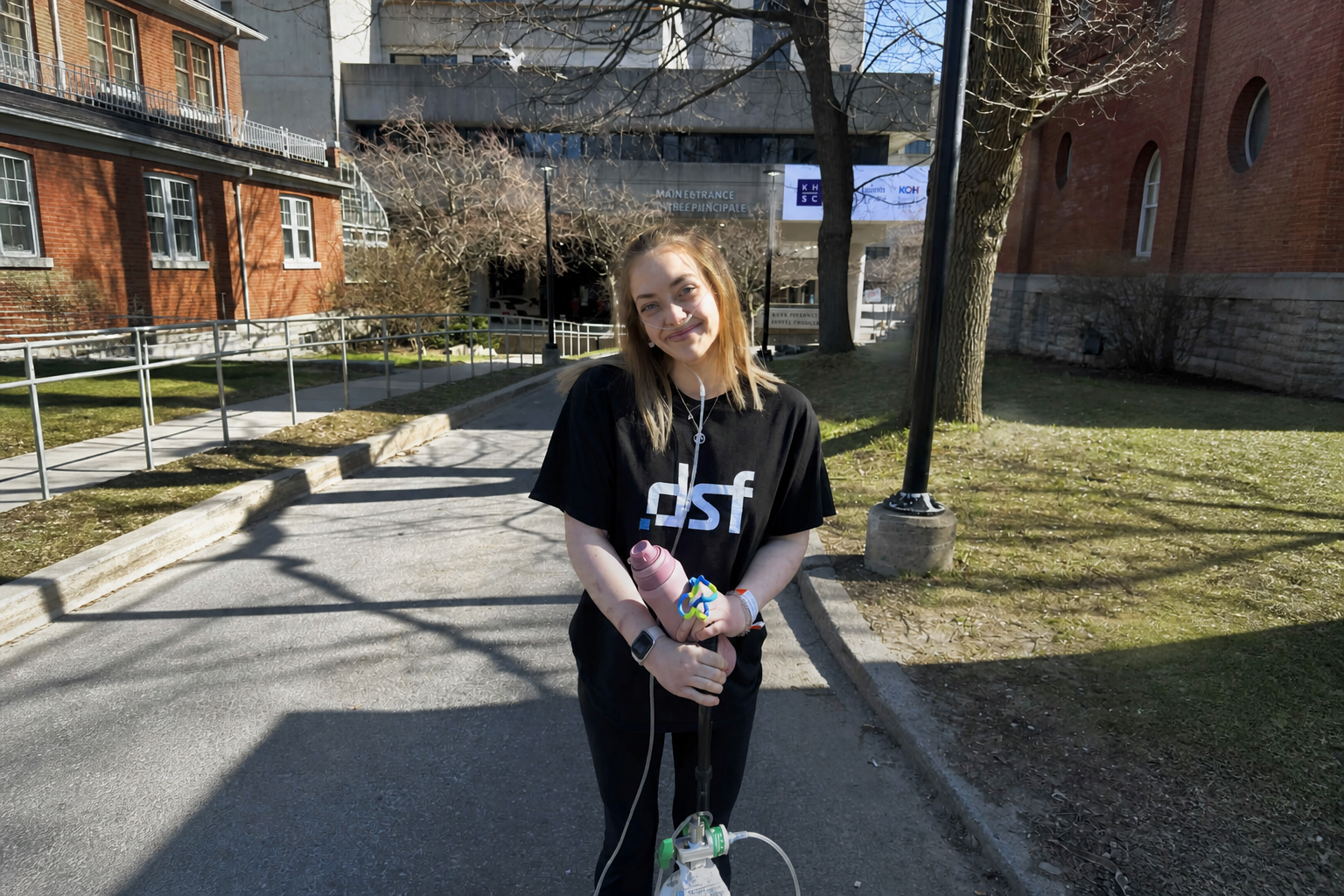
Les saines habitudes de vie avec la fibrose kystique: trouver un équilibre réaliste au quotidien
À 25 ans, Lex partage comment elle apprend à écouter son corps, à gérer son énergie et à trouver son propre équilibre avec la fibrose kystique, sans laisser la maladie définir qui elle est.
.jpg)
Aimer la vie et apprendre à la donner
Atteinte de fibrose kystique, Audrey refuse de se laisser définir par la maladie. Entre le deuil de son père, son combat pour la santé et son nouveau rôle de maman, découvrez le portrait d’une femme qui transforme chaque tempête en arc-en-ciel.