Testimonial: Hopes combined
The journey of a woman with cystic fibrosis whose hope, love and motherhood come together.
Testimonial by Élise Bouchard
Terrebonne (Quebec)
My name is Élise Bouchard, I am 33 years old and I have cystic fibrosis. The diagnosis was made as soon as I was born. I had surgery at 30 hours of life because my intestines were blocked due to an accumulation of meconium and secretions while still in my mother's womb. It was because of cystic fibrosis. I stayed in the hospital for several months. Without this operation I would not be here today to write this text.
At the time, the doctors told my parents that, given the severity of this condition, I should not be expected to live very old, with the median age of survival then being just about ten years. However, according to them, medication would make it possible to control the situation. I am the last of four children, so the doctors recommended that my parents take care of me as they cared for other children, but keeping in mind that I was more frail in terms of my lungs and digestion.
So my parents followed the doctors' recommendations. I grew up quickly, to follow my treatments and to take my medications, knowing full well that it was for my own good, so that I could stay alive. Nevertheless, I grew up and aged like my brothers and my sister. In elementary school, everything went normally. There were a few visits to the hospital, but nothing more. At that time, in my heart as a little girl, I told myself that I would recover from this disease, I had hope.
Then came adolescence. The median age of survival had then increased to the end of the 20s. I was still not healed, but I was still hopeful. I said to myself, “If researchers could at least find medications to prolong my life... I don't think I'll live long enough to hope for recovery, but at least live longer...” Granted, adolescence is a difficult time in life for everyone. However, it was an even more difficult time for the cystic fibrosis person that I am. Indeed, this is where the disease got worse.
I had to be hospitalized for the first time at the age of 13, during surgery for nasal polyps (common in people with cystic fibrosis). Afterwards, lung infections and hospital stays started to increase, and missed school days were felt — especially because I was a private college student. Fortunately, when I turned 15, the doctors told me that it was now possible to take intravenous treatments at home, using a pump that is carried in a waist bag. So my mom and I got the right training with the nurse — it was new and exciting! So I could go to school while having my treatments at home instead of in the hospital! A new way of living! This was a great innovation that I was able to benefit from. No more catch-up classes on the weekends to be at the same level as all my friends at school! Still full of hope, I finished high school without any problems and went to college for nursing.
Early adulthood went well, my condition was stable. I changed hospitals; I was able to continue receiving intravenous treatments at home, but using a different technology — small bottles that fit in a pocket! I have taken part in a few clinical studies involving new drugs. As the results were positive in my case, my inhalation treatments changed and became more effective. As a result, the number of lung infections has declined slightly.
A little later, the median age of survival had increased to thirty. I was still hopeful... hope to live even longer. My mindset at the time was this: “Now, there's the lung transplant. There are more and more, and it is going well. When I get there, I hope that lungs will be available for me, because that will then be my only hope of survival... However, new lungs are all well and good, but it does not heal the rest... There is no guarantee...”
Today, the median age of survival has risen to over 40 — hope is still there. I lead an active life while respecting my limits. I work in a different field than the one I studied in. Admittedly, taking time off work for health reasons is not always easy. Promotions are never for me, for a variety of reasons; however, I know very well that repeated absences and illness play a big part in these decisions. Despite everything, I am independent, I live one day at a time, and that suits me. I love life and every day I thank God for still being there. Every day I smile — it makes me feel good, I feel alive.
One fine day, I met an extraordinary man, François, who learned to discover my illness over the course of the days. He was so confident about the future with me that he proposed to me a few months after we met. The following year we were married! The hope for a bright future is reborn, day after day, with the ups and downs of the disease. I am always smiling. WE are always smiling. Despite the daily treatments that take several hours a day, despite the days when I want to let go of everything because I am tired, I smile and I say to myself: “Well let's see, you're still there... you have a lover who loves you... you have a lover who loves you, a beautiful house, love everywhere... Don't let go! You didn't come all that way to give up now! Life is good, enjoy it! ” This desire to live, to see life on the bright side was transmitted to me by my parents. I transformed it over the years in my own way. I am now hopeful for the future.
A few months ago, life gave me a precious gift: I gave birth to a beautiful baby boy, Eliott. Who would have believed it! I am already very proud of him. From now on, I want to multiply my hopes for recovery by millions, by billions! I do whatever it takes to make sure everything goes well.
Before pregnancy, we met with doctors at St-Luc Hospital, in general obstetric medicine and high-risk pregnancies, to get us to explain the risks and to ensure that everything went well during the pregnancy. Fortunately, my condition has been stable for several years, with FEV1[i] Of 65%, doctors were optimistic that everything was going well. So we opted for insemination, and the third attempt was a good one. We were thrilled but terrified at the same time. A healthy woman can easily get scared during a first pregnancy, this is normal. In my case, not only was it my first pregnancy, but I have cystic fibrosis. Nobody could predict how my pregnancy would turn out because there were no statistics. My husband was also afraid, but he accompanied and encouraged me with all his love. Uncertainty was also difficult for him, but I was happy, that was the most important thing. Our choice was well thought out and planned for at least a year, so we were going to try to take full advantage of this pregnancy, with its ups and downs.
The pregnancy follow-up was very close — every two weeks we had to go to the hospital. As early as the thirteenth week of pregnancy, I started having diabetes. I was losing weight instead of gaining it, but I was well monitored, everything went well, despite three superinfections. However, being used to receiving my intravenous treatments at home, the fact of having to be hospitalized, and in isolation at the top of the line due to an MRSA infection.[ii] — nothing to do with pregnancy! — was a tough test for me. Finally, the birth was induced at 37 weeks of pregnancy, because I was suffering from another superinfection and I was beginning to be exhausted. The birth went well, I even gave birth naturally! I knew that everything would be fine, I just had confidence in life.
The postnatal period was carefully planned, thanks to the help of our loved ones. The fatigue, the drinks at night, the treatments the next morning, the planning of our days... Luckily I have all the help I need. My son is now five months old; I am currently undergoing intravenous treatment, the first since giving birth. I was a bit afraid that I wouldn't make it, but in the end, everything went well. The helper (my mother, my sister, my mother-in-law, my stepfather... everyone has their morning) arrives in the morning and leaves after dinner. My husband arrives at the end of the day and takes over. It's a team effort! All this fighting is for the sole purpose of ensuring that my little Éliott does not lack anything. For all that means, I am the happiest woman in the world right now. All that this little being brings is more than anything I could have imagined. All my efforts have been rewarded. I now know that a little boy will look into my eyes and soon say, “I love you, Mom.” And again, just hearing the word “Mom” from her mouth, I'm sure it will bring tears to my eyes.
I want to live, I want to give hope to my son. I want to see my son take his first steps, I want to take him back to his first day of school, I want to console him when he has his first heartbreak. I want to be there for her graduation, I want to accompany her on her wedding day and who knows, I even hope to be a grandmother in my turn!
Since birth, I have been fighting this disease which, until now, cannot be cured. Life is good, and everyone deserves to live to the fullest. I am 33 years old, I am a mother... I am 33 years old, I want to be a mother for a long time...
[i] FEV1: Maximum Expiratory Volume per Second
[ii] MRSA: Methicillin-resistant Staphylococcus aureus
Interviews and testimonies
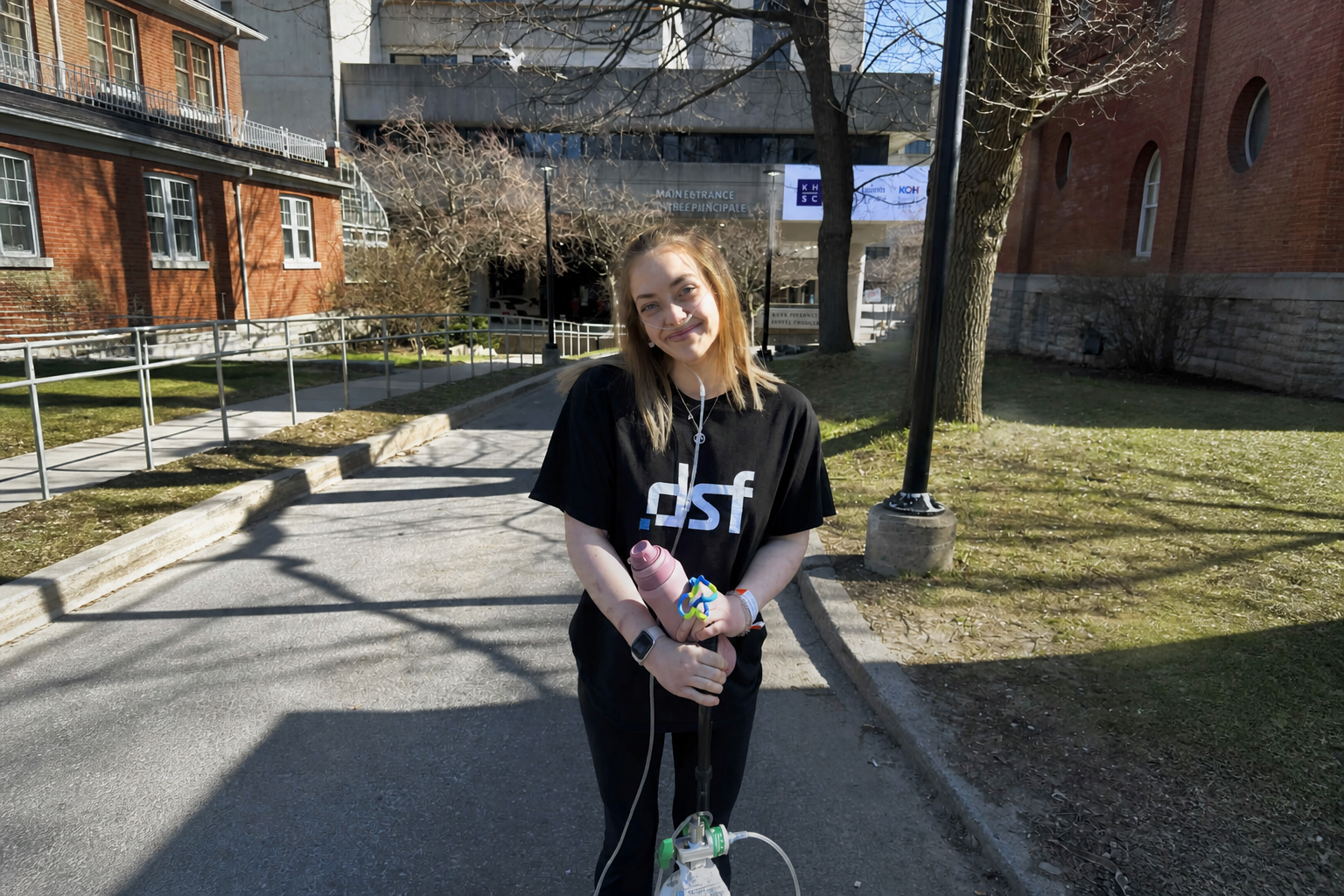
Les saines habitudes de vie avec la fibrose kystique: trouver un équilibre réaliste au quotidien
À 25 ans, Lex partage comment elle apprend à écouter son corps, à gérer son énergie et à trouver son propre équilibre avec la fibrose kystique, sans laisser la maladie définir qui elle est.
.jpg)
Aimer la vie et apprendre à la donner
Atteinte de fibrose kystique, Audrey refuse de se laisser définir par la maladie. Entre le deuil de son père, son combat pour la santé et son nouveau rôle de maman, découvrez le portrait d’une femme qui transforme chaque tempête en arc-en-ciel.