Interview with Richard Lavigne: inclusion, universal accessibility and social participation
Richard Lavigne, director general of the Confederation of Organizations of Handicapped Persons of Quebec (which counts the CPAFK among its members), has had a visual disability since birth. He has been campaigning for the cause of people with functional limitations for some thirty years. Here is a portrait of a passionate man who defends their rights — and who works so that our society can one day see things differently...
You have a visual impairment. Can you tell us a bit about your daily life and your life journey?
Since birth, I have seen a little bit of light, but I am functionally blind. It's not much use, except to know if it's light or not. I can't read or move around using sight or spot things or people. When I was young, I could see a bit more, but never enough to read and write. I learned Braille at the age of 5.
In the 1960s, blind children were sent to specialized schools. So, from 5 to 11 years old, I attended a specialized school run by the Grey Nuns in Montreal. Then, I attended a college run by the Clerics of Saint-Viateur, until the fourth year of secondary school. Afterwards, I went to high school, then to CEGEP and then to university.
Did you have access to adequate resources?
At the time, you had to get by. There were no programs or grants to hire coaches, readers, for example. Computers were not commonplace. We needed to find volunteers to read our books and record them on tape. We had to adapt, adjust ourselves, organize ourselves with the means at hand.
How did you get to the position of CEO of COPHAN?
At university, I studied a bit in political science, and then went on to law. Subsequently, I became interested in defending the rights of people with visual disabilities, initially in a community group for collective defense of rights. Little by little, I focused on the area of defending rights for all people with functional limitations.
I fought a lot, first of all for the blind, to defend their rights. Afterwards, I got involved in various COPHAN committees. In the 1990s, I also worked with other community groups.
In 1997, I was elected president of COPHAN. As such, I became more and more involved in cases involving various disabilities. In 2006, the major provincial groups of people with functional limitations hired me to assist and represent them when the Quebec government policy for persons with functional limitations, entitled “In equal shares”, was rewritten, which became the “In full” policy and was adopted in 2009. I represented these groups at 17 round tables and in discussion groups that brought together representatives of associations, ministries and the OPHQ (Office des Personnes Handicapées du Québec), in order to develop a policy proposal.
In 2008, when I finished my contract, COPHAN opened a CEO position and hired me. I've been here ever since.
The COPHAN website is currently under reconstruction. Will the new site be online soon?
It should be launched next December, if all goes well. We recently completed a COPHAN strategic planning exercise, during which we reviewed our values, vision, etc. The website needs to be updated accordingly. We also need to make it accessible to everyone, technically, for all people with functional limitations. Among other things, we want to include capsules in Quebec sign language, in order to make it accessible for people with hearing disabilities. We also want people who use a Braille device to be able to navigate independently and appropriately. The content of the site was also written in simplified language, in order to make it easier for people with cognitive limitations to read it. In other words, we want to lead by example and offer a site that is accessible to everyone.
You say you have reviewed the vision and values of COPHAN. Can you tell us more about this?
The mission hasn't really changed — it's been updated. Over time, speech and the words to say it have evolved. At one time, we talked about disabled people, disabled people, then disabled people; today, we talk about people with disabilities Or with functional limitations.
COPHAN — and more and more partners — has been working for several years on the causes of disability situations. Thus, we need to specify why a person has a disability.
There are two factors. The first relates to the particularities of the person: limitations at the motor level (someone who cannot walk), visual (who cannot see properly), auditory (who does not hear properly), cognitive (who has difficulty understanding or concentrating), etc. The second factor concerns physical, political, social, cultural and economic environments. If these environments are adequate (universally accessible), designed in such a way that everyone can benefit from them, taking into account everyone's functional limitations, the situations of disability are much less severe. We therefore work on both levels: to correct environments in order to make them universally accessible, and so that people with limitations can obtain treatments, services, programs, technical assistance, etc. in order to reduce situations of disability. When we are successful at both levels, disability situations are reduced or even absent. For example, if someone gives me a book in Braille, I am no longer disabled in terms of reading because I can read. If I am given a safer urban environment, it's good for me who is blind, but also for everyone else. In this way, the needs of people can be met, regardless of whether they have a disability or not.
Therefore, we have reviewed the mission of COPHAN, keeping in mind that the objective of the Confederation is to promote full social participation people living with disabilities, as well as that of their families. It is therefore not necessarily a question of “integration”, but of participation. If the person wishes to do so in a less “integrated” environment, that is their right. However, the ultimate objective of all citizens, whether disabled or not, is to participate, in accordance with their will and abilities, in society economically, socially, culturally, politically, etc. Our objective is therefore to promote full social participation by respecting the choices that the person is entitled to exercise. It is not up to us to decide what is good and what is not. What we want is for the environments in which this person evolves to be designed in such a way that they can freely exercise their choices and participate actively in the development of society.
Can you explain to us the difference between the notions of integration and inclusion?
We are working a lot on an inclusive approach. When we talk about integration, we take a person and insert them into something that exists. It is up to the individual to adjust. When we talk about an inclusive approach, we promote the establishment or revision or planning of programs, services, places, etc. so that, from the start, we expect to be able to include everyone. We then talk about accessibility, or universal design.
Criteria for inclusion
To “achieve” inclusion, certain criteria must be met. COPHAN favors this approach according to four criteria. The first is universal accessibility, which consists in planning for the construction of buildings or the manufacture of things, or in planning programs and services, etc., so that everyone can benefit from them in the same way and at the same time.
The second inclusion criterion relates to the issue of reasonable accommodation, a concept aimed at anyone with special needs. It is differential treatment, not equal treatment, the establishment of measures to accommodate a person so that they can exercise their rights on the same basis as others. The Supreme Court of Canada identified the three criteria for accommodation: feasibility, safety for all, and undue hardship. According to a judgment of this Court[1], “undue hardship” means an accommodation cost that is such that it may jeopardize the nature of the business or program. Thus, in order to be able to refuse an accommodation, it is necessary to demonstrate that it is really too expensive.
The third inclusion criterion is compensation for the costs that a person must assume to overcome their functional limitations and the situations of disability they encounter. Indeed, a person with functional limitations must cover certain costs directly related to their disability. For example, paying more for accessible housing or close to services, a support service to go to the theater, a specialized childcare service for an autistic child.
Finally, the fourth inclusion criterion is access to programs, services and measures that are aimed at the entire population. In other words, COPHAN no longer wants programs and services to be set up in parallel with those aimed at the entire population. She hopes that eventually, specialized services for people with functional limitations will no longer be offered in separate buildings, but rather be included in the services offered to the entire population, in the same premises as the population. Let's stop having two parallel worlds; instead, let's create a single world in which everyone can evolve at the same time.
Why focus on inclusion over integration?
It is often said that so-called non-disabled people are not aware, or are poorly aware, of the expectations, needs and aspirations of people with functional limitations. Now, if we don't see them, if we don't encounter them, if we don't discuss them with them, how could we overcome prejudices? People will not be able to understand their situation and therefore agree with the actions to be taken. In my 30 years of experience, I have found that if I take the trouble to explain my needs to someone who does not understand, in less than ten minutes the person understands everything and says to me, “That's right, I didn't think of it.”
If we stopped having parallel worlds, people with functional limitations would be better understood and probably more comfortable with people who don't. In the medium term, you would save money if you stopped paying twice.
That is why COPHAN has revised its ways of doing things to promote inclusion and full social participation. This is an issue for everyone, not just for the people we represent.
COPHAN — which brings together just over fifty member organizations — does not require privileges. We ask for measures to be equal, to be able to participate independently, with our free choice and in our measure, in the development of society. We no longer want to get things out of charity. Instead, we want them to be recognized as ways to exercise this right to equality.
Deconstructing prejudices
Today, many people with functional limitations want to work. Moreover, on behalf of COPHAN, I have already participated in a parliamentary committee of the National Assembly in Quebec City to claim the right to pay tax — to everyone's surprise! In fact, if you pay taxes, unless you are rich, it is because you work. If we cannot work, we are considered beneficiaries, beneficiaries, poor people who need help. Yes, we need help, but not only that.
Our challenge is also to overcome prejudices, positive or negative. When you are different, you are either better than the others or you are worse. I've already heard “Oh, how courageous you are! ” No, I am not brave, I want to eat, I have no choice! If I work, it's not a question of courage, it's a question of survival, like most of the world!
In the same way, how can a person with functional limitations who are continuously belittled feel useful? It is difficult for her to convince herself that she has abilities and that she can participate in the development of society. It is therefore necessary to deconstruct this image rather than designing “band-aid” programs that apply a balm to the problem rather than addressing the source.
At present, what is the situation of people with organic functional limitations?
The situation is different from that of people with motor limitations, for example those who use wheelchairs. Indeed, thanks to the efforts made over the last 30 years, we see more and more of them on the sidewalks and everywhere. In the years 80-90s, a lot of work was done on physical accessibility: access ramps, accessible washrooms, elevators, etc.
When it comes to other types of limitations, it's sometimes more difficult. Unfortunately, we cannot defend all fronts at the same time, and some advocacy movements have undoubtedly been more successful than others. As for the measures to be put in place to meet organic, sensory or intellectual needs, they are of a different nature. The limitations are sometimes less visible and varied situations often require more complex measures than the “simple” addition of an access ramp. In particular, in the case of a transplanted person, several aspects need to be examined: medication, lifestyle, irregular schedule, transport (schedule affecting treatments). The issues are different from those of people with functional motor limitations. The latter are no less, only different.
Overall, the situation is much better than it was 30 years ago. At the time, a small measure was applied, and it was extraordinary, because nothing existed. The further you go, the more complicated it gets. Today, the context has changed, the situation has evolved. We specify, we nuance, we articulate. Since they want to participate actively in the development of society, people with functional limitations, who are often more educated than before, are now more demanding, of themselves and of others and their environment. They want to have the resources at their disposal.
Take the employment sector. No matter how much we talk about “integration”, we have to work on work schedules and collective agreements to adapt them. For example, for a given position, consider a person with functional limitations that make it impossible to do part of the task. Will unions and managers agree to modify the task in order to encourage hiring? What will co-workers say? This is an important question.
Changing practices and systems
Unions, employees and management must therefore be interested in adopting new practices. When it comes to setting up workplaces, there are usually not too many problems. On the other hand, when we talk about changing working conditions, schedules, tasks, collective agreements, we have to face more resistance, because it requires more planning. It's more complicated. Thus, we are no longer in the process of installing access ramps, accessible washrooms or providing documents in Braille. We need to go further, involve the entire organization, change the overall functioning of the current system. People with functional limitations also have Capabilities. Just as a seller relies on the capabilities of their product, we must rely on the abilities of people with functional limitations.
Thus, as an organization for the collective defense of rights, COPHAN had to review its ways of doing things and its strategies. Demonstrations and signs have less effect than before. Instead, we need to convince our partners, work with them to find solutions, collaborate rather than confront, while continuing to move forward. This is one of the major challenges for organizations like COPHAN: to avoid falling into the paralysis of an unsuccessful partnership. Establishing partnerships that focus on results is important. It requires good faith, will on both sides, and recognition of the need to find solutions. COPHAN prefers to adopt an approach based on the following leitmotif: “Let's work together to solve the problem”. If we realize that a partner is trying to throw powder in our eyes, we withdraw. We need to learn, without letting go of our concerns, not to frighten people, while being careful not to fall into the trap of inaction.
I imagine that winning a battle should provide a profound sense of satisfaction?
I have to admit that we haven't won a battle in a long time — and we don't often win one... When you look at the big picture, you see some evolution here and there. However, there is no concerted global action plan. Even if everyone goes a long way, program managers and the various levels of government seem to have problems with communication and delegation of authority. Not to mention the war of powers. That's why it's becoming more and more difficult to work collaboratively.
Earlier, you listed some of the laws, agreements, and policies that have been put in place to ensure the exercise of the rights of persons with functional limitations. In your opinion, are they well applied in Quebec both in the private and in the public?
Quebec has established numerous laws. Are they well applied? No more and no less than the other laws, in my opinion. Never enough. Even though the texts are imperfect, we still need to work on implementing them. However, one of the main arguments relates to the ability to pay. People tend to find reasons why they can't fix a problem rather than working to find ways to fix the problem. It's all a question of attitude, of the angle of analysis: “What can I do to solve the problem? rather than “Why can't I fix the problem?” ”.
In my opinion, we have correct laws and policies but there is still discrimination, injustice, exploitation, misapplied measures, misunderstandings... Laws are only good if the people responsible for enforcing them believe in them and act accordingly. A law alone has no value. A text is simply written; what matters is what you do with it.
Quebec signed the Canadian Health Pact, based on the Canada Health Act, whose main principles are: universality, public management, accessibility, transferability and comprehensiveness[2], [3]. As an example, let's take home support. Why is it that several people have to pay for this service? However, it is a health service! Often, officials feel that this does not meet the criteria of Canadian law, that they are not required to offer this service free of charge. We, COPHAN, consider home support services to be a basic, essential health service that must be provided by the health and social services network. How can we partner with someone who tells us “I don't have to, I don't have to” and who doesn't feel bound by the criteria of Canada Health Act? It's all about interpretation by both parties.
If we think about the road ahead, we talk about awareness, about seeing abilities over disabilities, but is the lack of financial resources holding back change and initiatives?
Federal and provincial governments are investing billions of dollars in loan guarantees for businesses, as was the case during the auto crisis. We then speak of “investments”. On the other hand, when it comes to providing transport, home support or other services for a person with functional limitations in order to allow them to go to work or play, why do we speak of “expenses”? When you want to find budgets, you find them. Quebec is a rich society and it is wrong to pretend that you cannot afford good services. These are choices that are made by our governments. What I do know is that a large number of people with functional limitations fight, many, every day to survive. Take for example the case of transplants (kidneys, pancreas, lungs). They fight a lot, sometimes for a long time, to survive. However, once they recover, they are refused to be offered a part-time position, or they are paid so little that they remain below the poverty line.
Poverty is a plague; people with functional limitations are still among the poorest in society, the most excluded and the most isolated. I admit that things have changed in 30 years, but this problem really needs to be addressed.
My dad told me, “After a while, when you do things and things don't change, change the way you do things.” That's why we need to adopt, collectively — that is, people with functional limitations, decision makers And the entire population — a new vision, so that everyone can contribute to Quebec society. An inclusive approach allows everyone to feel equal to the other.
It's all a matter of choice. COPHAN's job is to try to convince people to make the right choices. Thus, the more things progress, the more complex the situation is; it all comes down to nuances. Defending rights has therefore become a specialty, because we are dealing with people who tend to justify a problem rather than find solutions. We lack global strategic action plans, a vision. I thought that only the blind had no vision... [Laughs]
References
Confederation of Organizations of Persons with Disabilities in Quebec (COPHAN)
www.cophan.org
Quebec Office for Persons with Disabilities
http://www.ophq.gouv.qc.ca/
Regrouping of the blind and amblyopic of metropolitan Montreal
http://www.raamm.org/
“Fully fledged” policy, adopted in 2009
http://www.ophq.gouv.qc.ca/fileadmin/documents/Politique_a_part_entiere_Acc.pdf
Provincial home support policy
http://publications.msss.gouv.qc.ca/acrobat/f/documentation/2002/02-704-01.pdf
Special Education Policy
http://www.mels.gouv.qc.ca/dgfj/das/orientations/politique.html
Law ensuring the exercise of the rights of persons with disabilities
http://www2.publicationsduquebec.gouv.qc.ca/dynamicSearch/telecharge.php?type=2&file=/E_20_1/E20_1.html
Canada Health Act
http://lois-laws.justice.gc.ca/fra/lois/C-6/index.html
Human Rights Charter
http://www2.publicationsduquebec.gouv.qc.ca/dynamicSearch/telecharge.php?type=2&file=/C_12/C12.HTM
Equal access to employment: Guide for the integration of persons with disabilities
http://www.cdpdj.qc.ca/DPAESC/Documents/89-Guide-integration-personnes-handicapees.pdf
[1] http://www.iijcan.org/fr/ca/csc/doc/1985/1985canlii18/1985canlii18.html, para. 23
[2] http://www.med.uottawa.ca/sim/data/Canada_Health_Act_f.htm
[3] http://lois-laws.justice.gc.ca/fra/lois/C-6/index.html
Interviews and testimonies
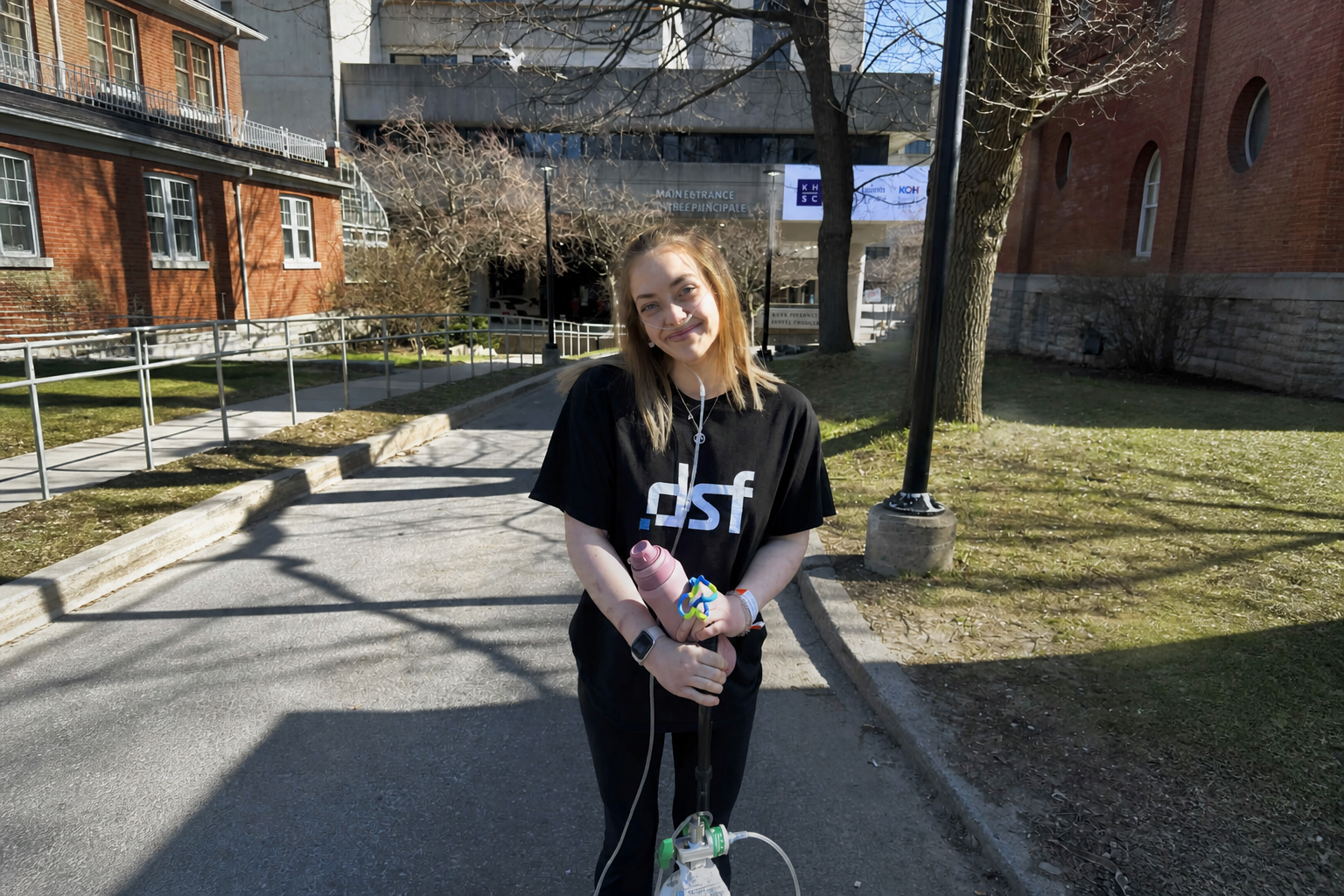
Les saines habitudes de vie avec la fibrose kystique: trouver un équilibre réaliste au quotidien
À 25 ans, Lex partage comment elle apprend à écouter son corps, à gérer son énergie et à trouver son propre équilibre avec la fibrose kystique, sans laisser la maladie définir qui elle est.
.jpg)
Aimer la vie et apprendre à la donner
Atteinte de fibrose kystique, Audrey refuse de se laisser définir par la maladie. Entre le deuil de son père, son combat pour la santé et son nouveau rôle de maman, découvrez le portrait d’une femme qui transforme chaque tempête en arc-en-ciel.