Resilience, commitment and humanization of care
A psychologist living with cystic fibrosis and a liver transplant recipient, Valérie Gosselin shares her journey marked by resilience, social commitment and the desire to humanize health care.
Valérie Gosselin, a psychologist graduated from Laval University, was the recipient of the prestigious Forces Avenir scholarship in 2003, which highlighted the quality of her academic results, her social involvement and the fact that she passed her bachelor's degree within the normally prescribed time frame, despite the illness. During her studies, she also obtained a master's scholarship and a doctoral scholarship. More recently, in November 2011, she received the award from the Association of Young Graduates of Laval University. This award is offered each year to four graduates who have distinguished themselves in their careers; it is one of the most prestigious of Laval University. It is her success with the Amis-Maux Clinic that allowed her to obtain this recognition. Interview with a career woman with a big heart.
Do you consider that your childhood was greatly disrupted by cystic fibrosis?
I was diagnosed when I was two and a half months old. However, it was during adolescence that the disease took more space, in that I discovered my physical limitations quite quickly and felt the difference between myself and other young people my age. I chose a sports-study program in synchronized swimming. At first, I had trouble staying under water for more than 13 seconds — in comparison, the others held their breath for about 30 seconds. Despite my best efforts in training, I couldn't get the same results as the others.
However, I think that this training saved my life, despite what the doctors said. Humidity, water, and training 15 to 20 hours a week had the same effect on me as clapping sessions. At one point, my breathing capacity had even reached a rate of 113%.
Why did you choose synchronized swimming over dance, for example?
I liked that! I saw Caroline Waldo at the 1988 Olympics and was very impressed. I dreamed of doing the same things; I think I had the talent but I didn't have the stamina to do it. The final year of the sports-studies program, I even won the solo provincial championships in the novice category. In CEGEP, I opted to compete in swimming; I didn't win anything like that, but I participated in the provincial championships, and I finished in the top five or six in the freestyle, which was my specialty. During my second year of CEGEP, I felt very weak, I was losing a lot of weight and I no longer had any reservations, so I had to slow down the competition. The doctors discovered a year later that I also had diabetes; now I had to inject myself with insulin. What a shock at that time!
Once at university, why did you study psychology? What obstacles did you have to overcome in order to succeed?
First of all, I am very curious about human behavior. Around the age of seven, I confided to my mother that I would have liked to be a priest to know what was said at Confesse, what happened in people's lives! I am always looking to understand human behavior, without judging, pure and simple curiosity.
I started university at 19; a year later, I started to feel worse and had to go to the hospital more and more often because of my liver cirrhosis which was causing internal bleeding (bursting esophageal varices). I was a high achiever; I wanted to get scholarships at the master's and doctoral levels. Thanks to the help of my friends who brought their course notes to the hospital as well as to my combative temperament, and by dividing my courses over summer sessions, I managed to obtain one of the three scholarships for the master's degree, then another for the doctorate, and then another for the doctorate, all within the prescribed study period.
In 2003, during your doctorate, you launched your Amis-Maux clinic. Can you tell us more about this?
As part of a non-thesis work, I looked at animal therapy. Before choosing psychology, I considered being a veterinarian, but since I was not very interested in the biological aspect, I preferred to focus on the study of human behavior.
In addition, my doctoral studies, which focused on neuropsychology, were a bit boring. At that time, my numerous hospital stays made me realize that the current health system is sometimes such that it makes us feel like numbers. So I wanted to do my part and help humanize health care through animals. In my opinion, they bring out the purest side of the human being, the quietest, the most beautiful.
Setting up my clinic was a new challenge for me. The beginning was difficult; they wanted to observe me before giving me a chance. I submitted applications to employee assistance programs, approached schools, doctors, clinics... However, the day I started relying on the fact that I was a certified psychologist, I started to be taken seriously.
It is the first clinic of its kind in Quebec. Currently, a team of a dozen doctors are considering opening a clinic near ours and want to join us. It is a new project, the dream of every stakeholder to work with doctors.
What intervention methods are used at Amis-Maux?
We give conferences, we go to daycares, to schools, to businesses, we meet people individually or in groups. We also offer consultation services by phone, email, and Skype; it's more difficult because we can't read body language, but it can make things easier for busy people, or for example for people who are sick, agoraphobic, uncomfortable, or simply don't want a face-to-face appointment. However, it is a common practice elsewhere in the world, especially in France.
What is your preferred intervention method?
Certainly the conferences. It is very rewarding for me. People who attended one of my conferences three years ago are still emailing me. I feel that talking about my life experience brings a lot to those who attend. Among other things, the conferences I give to groups of elderly people are for me the most enriching, because I see in their attitude that my words really resonate with them. Some come up to me afterwards and tell me that I made them realize that they are not alone in going through these emotions, these difficult experiences, and that it is possible to stick it out. In addition, my curiosity about the lives of others is satisfied by my role as a supervisor at the clinic, by the consultations with stakeholders who ask me for advice on certain issues.
I also really enjoy being a consultant in the media, for example to give radio interviews or advice on television on various topics. Indeed, I love communication. Conferences allow me to reach a large number of people at once, to discover the experiences of others and especially to get feedback.
You had a liver transplant in 2010. How did you have this experience?
I was bedridden at home for six months before going to the hospital for the transplant. I looked like a woman who was nine months pregnant, my belly full of ascites, a liquid produced by a diseased liver. The doctors did not want to put me on the waiting list, because I was considered to be in the “gray zone”, that is to say, sick, but not sick enough... One day at the end of January 2010, when I was in the emergency room to get a five-liter ascites puncture, I even asked my doctor in Quebec to help me die since I was in a lot of pain and I saw no other solution... It was at that moment that things started to move.
Specialists at Saint-Luc Hospital in Montreal then assessed my condition and decided to urgently put me on the transplant waiting list. Given the urgency of my situation, I was supposed to wait at most three weeks; however, as there was a shortage of livers (I am Type 0+, a very common type), I had to wait three months in the hospital hoping for a miracle anyway. During this time, I was being fed intravenously because I was unable to eat. When I received my liver, it was one to midnight!
In addition, because I also have osteoporosis and was given a lot of cortisone, I fractured 24 ribs in two years; at some point during the months of waiting in the hospital, five rib fractures added to my suffering. The mucus got stuck in my lungs; I was on oxygen all the time. The doctors considered getting a lung transplant at some point, but I would have had to wait longer and they weren't sure that I could wait that long and that I would survive the surgery.
How did you get through this period of waiting and uncertainty?
From around the age of 25, after studying psychology, I became interested in everything related to death and spirituality. I tried to cope with my own death in this way, and this preparation helped me a lot. I was very serene in this wait. I was at the point where both options, transplant and death, were both equally desirable in the sense that they would ease my suffering.
I believe that we are on Earth to learn, that we are in the school of life. It is a kind of playground, to learn to love yourself and others unconditionally, pure and simple. It was this belief that helped me get through the transplant, to think that every experience in life is useful and teaches us something. I tried to live in gratitude, to the nurses, to the doctors, to my family. I once read this adage: “To envy what you don't have is to waste what you don't have.” It was my reading and meditations that helped me through this period of waiting and pain.
However, I have experienced moments of discouragement, it is inevitable due to suffering, to see my quality of life deteriorate, to become dependent on others even to go to the toilet and wash (it is very difficult for someone who is extremely independent!).
How did you experience the post-transplant period?
It was a great disillusionment. The suffering has not stopped. It was a monumental shock for me. I had never considered this third option, according to which the suffering would not end despite the transplant. I even asked myself if I would have preferred to die. I let myself go, I gave up. I had lost the will to live. Half of my hospital roommates had died, some before the transplant, others after. The backlash from waiting for a transplant has been very strong. Getting back on track was so difficult for me that I had to be hospitalized for another eight months after my transplant.
I remember an interview with Guy Corneau talking about his fight against cancer and saying that he found the period of remission more difficult than the fight itself. I was then really reassured to know that I was not the only one who felt this way! I felt awfully guilty for all this frustration at the pain that was going on, even though I was lucky enough to have survived thanks to a transplant.
A year and a half passed before I started to see the light at the end of the tunnel. I went back to work gradually a few months ago; it helped me a lot, because I no longer feel useless! I went back to giving conferences, giving interviews in the media, on various topics. Going back to work cheered me up a lot and re-energized me.
Has this ordeal changed your philosophy of life?
Performance is a very important part of my personality. However, the transplant made me realize that after all, you lose your life to stress yourself to be successful. Regardless of the number of awards, awards, medals, we all end up in a blue jacket. Regardless of your status, prisoner or model little girl, we all have to go through it and we are all equal in the face of death. This finding came as a big shock to me. At first I felt a lot of frustration, but once I accepted that fact, I felt so liberated! It was there that I decided to start living for myself rather than for others.
On the other hand, for a while, it seemed to me that it was not enough to hold on to life. I was wondering who and what I was for, I had no boyfriend, no children, so I couldn't see what to hang on to. I realized that even if I disappeared, almost nothing would change in people's lives. It was a hard observation, quite an adaptation, an important turning point in my way of seeing things.
Today, I rely a lot on gratitude. I try to focus on all the positive aspects, to see what I have rather than what I don't have. There is always something going well in life. I have learned in neuropsychology and through my reading in spirituality and quantum physics that everything is energy and vibration; I believe that when you live in gratitude, the brain frequencies are higher and provide feelings of joy and happiness, while the lower frequencies, which correspond to a decrease in energy, cause more negative feelings. You also have to keep faith, trust in life, always set goals to find the strength to fight.
And now, what are Valérie's goals, personal and professional?
On a professional level, I would like to be able to present one conference per week. In addition, I decided to take on a new challenge: to set up a research chair on the humanization of health care. Thus, I have already managed to speak in person about this chair to Minister Bolduc and Mr. Jean Charest; a meeting should take place in the coming weeks — it is very exciting!
On a personal level, I have set myself three goals. The first is to take care of myself — to eat well, to sleep well, to have fun, every day, to stop being constantly in effort. I have often overlooked these aspects of my life in favor of performance. The second aims to feel useful, in particular by giving more conferences on behalf of the Amis-Maux Clinic and to make my chair project a reality. Last but not least, find love! ...
The final word?
About his fight against cancer, Guy Corneau said that he had to find pleasure on a daily basis, have fun, that this is how he was able to hang on to life. For my part, crafts, drawing, scrapbooking saved me after the transplant. Indeed, during my endless stay in the hospital, my mother bought me the equipment I needed; this activity, this small pleasure, motivated me to get up every day, to eat, to drink, to live. Thus, I understood that it is not always necessary to set big goals... You just have to enjoy yourself, every day, a simple little pleasure, and the whole day will be brighter.
Interviews and testimonies
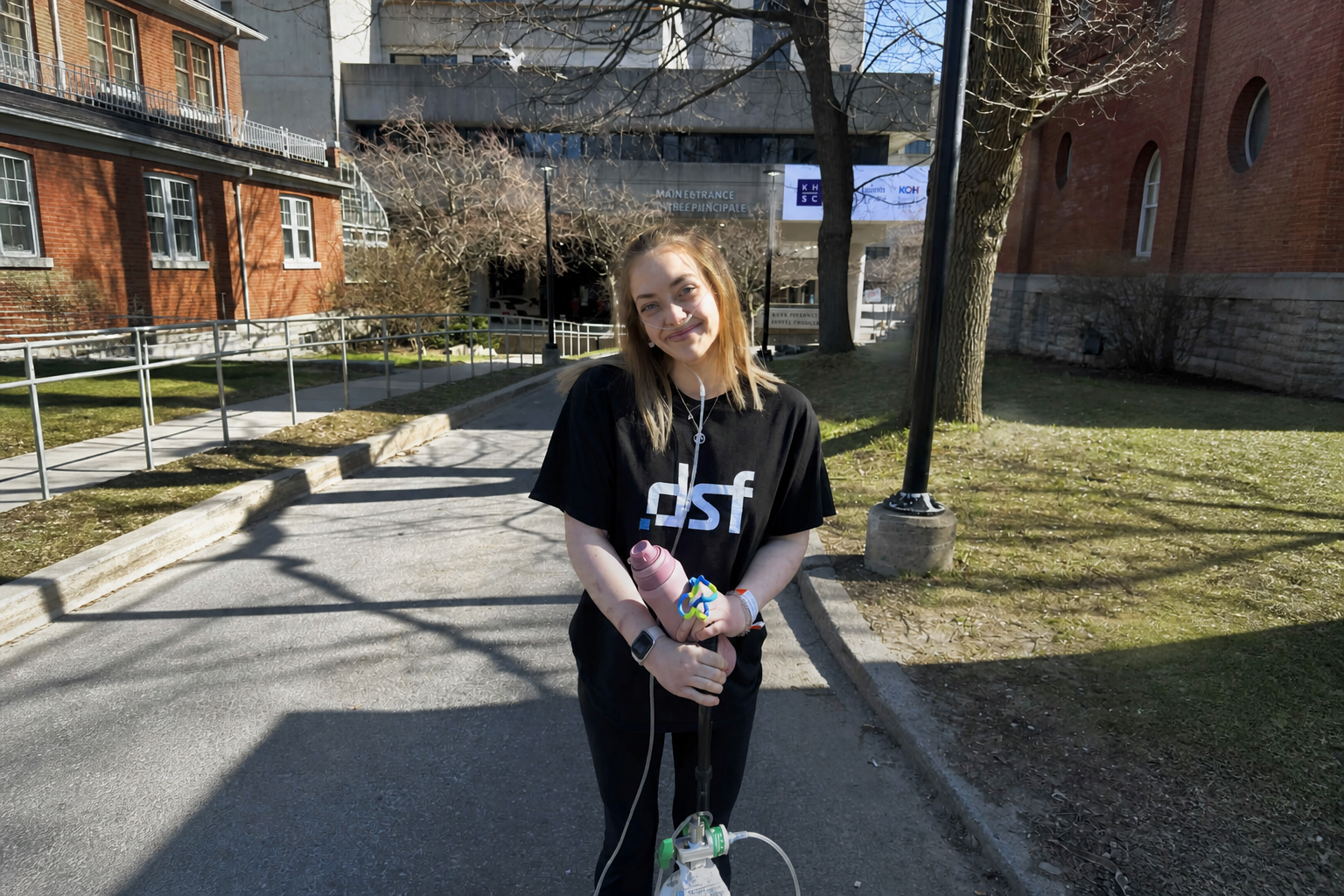
Les saines habitudes de vie avec la fibrose kystique: trouver un équilibre réaliste au quotidien
À 25 ans, Lex partage comment elle apprend à écouter son corps, à gérer son énergie et à trouver son propre équilibre avec la fibrose kystique, sans laisser la maladie définir qui elle est.
.jpg)
Aimer la vie et apprendre à la donner
Atteinte de fibrose kystique, Audrey refuse de se laisser définir par la maladie. Entre le deuil de son père, son combat pour la santé et son nouveau rôle de maman, découvrez le portrait d’une femme qui transforme chaque tempête en arc-en-ciel.