End-of-life care: a law born of dialogue
A human and political reflection on the end of life, autonomy and the role of elected officials in health.
Interviewed by Tomy-Richard Leboeuf McGregor
Montreal (Quebec)
Interview with Véronique Hivon, instigator of the law concerning end-of-life care
A seasoned lawyer, committed politician, mother and passionate about social justice and health issues, Véronique Hivon is a captivating figure in Quebec politics. Graduated in law from McGill University in 1994, she then continued her studies at the London School of Economics and Political Science, in England, where she will learn more about the role that social measures can play in the community.
She who is often defined as an anti-politician can boast of being just as popular and appreciated among supporters of her political party as with the population and several opponents. Entering politics with the conviction that things had to be changed from within, she became deputy for Joliette in December 2008. In 2012, then a member of the Council of Ministers, she introduced Bill 52, entitled End-of-life care law.
Interview with a politician who was able to manage a thorny issue, which caused important discussions among people living with cystic fibrosis and the Quebec population as a whole.
Madame Hivon, why did you get into politics?
I first worked as a political attaché for two ministers, then I worked as a lawyer for the Quebec government. I was also involved as an activist within my party and several people told me that I had the qualities necessary to come to the forefront. I am someone who really enjoys meeting people and sharing my views. Over time, I wanted to develop my own professional skills and complete my commitment.
Three profound reasons definitely convinced me to take the plunge. First, I felt that the new generation had to take their place in politics. As you know, I am a separatist and it is important for me to renew our discourse. Then, the issue of social justice appealed to me and I felt that it should be made a priority. Finally, I took the plunge because I wanted to change things from within. This is a strong theme of my commitment, I know that there is a real disconnection between citizens and politics. I understand this disconnect: people no longer want to see politicians act in the traditional way. I wanted to change things!
In the 2012 elections, you were re-elected as the Member of Parliament for Joliette and joined the Government of Quebec. What were your responsibilities then?
The Premier of Quebec, Pauline Marois, has given me several responsibilities. First, I was appointed Minister Responsible for Social Services and Minister responsible for everything related to end-of-life care issues. I was also the minister responsible for my region, Lanaudière. You should know that the Ministry of Social Services is a big responsibility, more than 7 billion dollars are attributed to it. Its role is very important because it affects all areas of people's well-being, whether they are physically disabled, autistic, addicted or homeless, not to mention the issue of youth protection. In short, everything that directly or indirectly relates to social issues. As you can see, it was diverse!
On June 12, 2013, at the National Assembly, you submitted the draft of the 52, entitled End-of-life care law. Where did you get the idea?
This is an idea that I put forward from the beginning of my political commitment, for several reasons. During my law studies, I understood the importance of the person's autonomy so that they could decide their own fate. I've read a lot of case law on the subject, including the famous Sue Rodriguez case. Suffering from an incurable disease, she embarked on a long legal battle in 1992, claiming the right to die with dignity by obtaining the help of a doctor. She then appealed to the Supreme Court of Canada. The judges, in a very close result (5 against 4), refused to grant his request. I had also had the chance to take courses in medical ethics.
And then, I myself was confronted with this situation, because people close to me, at the end of life, suffered a lot. I have also known people who have had access to exceptional end of life care. For all these reasons, I have had the time and the need to think about this question on multiple occasions and at different times.
Politically, I believed it was essential for elected officials to address this issue. We should not wait for the courts to chart the way, in favor or not, of a project in this direction. I am convinced that for such delicate subjects, you have to roll up your sleeves and work with the population. Elected officials must dare to tackle this type of issue rather than wash their hands off them because these are difficult questions that can offend some of the electorate. We have to take responsibility!
Several people opposed physician-assisted dying. How did you manage to build broad support from the population?
First, we took as much time as was necessary to complete various consultations. For issues of such importance, it is imperative to give yourself the means to succeed. When trying to make significant social and human changes, you have to be in tune with the population. By working well at all stages, you can build the consensus you need.
I would also say that we were able to work in a non-partisan way. We set up a commission that went to meet people in various cities in Quebec. It should be remembered that the issue was not only about medical assistance in dying, it was also about all end-of-life care. We had to ask ourselves how to best support people in this situation that we will all experience one day. This project therefore also concerned palliative care or advance directives, for example. I think that this reassured a part of the population a lot, we really wanted the people affected by this care to be at the heart of decision-making.
In the opinion of a majority of the population, this bill had become unavoidable and was a real breakthrough for society. This is why we wanted to work collectively so much: this project had to be a success. People from all walks of life have put their two cents in, thus contributing to the positive improvement of our approach. So even the people who were A prima facie against this project were no longer resistant to it in the end.
Allowing ourselves as much time as we needed also allowed us to get our message across well in the media. All the medical, legal or ethical issues that were raised were relayed to the population and debated, making it possible to gradually move forward those who were still hesitant.
What are the main differences between medical assistance in dying and palliative care?
When we talk about palliative care, we are talking about relieving both the physical and moral suffering of the person, but also of those around them. It is about treating the person in a global and holistic approach, taking into account all of their needs so that they feel good. It is therefore not a question of causing death, but of supporting the person at the end of life calmly.
Regarding medical assistance in dying, this is an element for an exceptional, very specific situation, in cases where, despite the best care at our disposal, we cannot manage to alleviate all the suffering suffered. This leads to a lot of physiological and psychological distress. Thus, thanks to the help of medical personnel, the person can leave peacefully according to their wishes, and put an end to intolerable suffering, when it no longer makes sense for them.
The federal government was forced, by the Supreme Court, to authorize physician-assisted dying across Canada. Are there differences between Quebec law and Canadian law?
Yes, there are a few differences that are important. Federal law allows for two forms of medical assistance in dying, as it also includes assisted suicide. In Quebec, death is caused by an injection administered by a doctor: it is the medical world that acts. At the federal level, there may be cases where the person himself, through another protocol, administers the death. Concretely, in Quebec, we have made the choice to include medical assistance in dying as a service provided within the health system, in a “continuum” of end-of-life care. The other aspect is that federally, a person with a severe disability could ask to use it, while in Quebec only people with a serious and incurable illness and who are at the end of life can request it.
The time when it can be used is also different. In our law, we have written that the person must be at the end of life, but we have not defined a specific period of time in order to have some flexibility and to allow each situation to be interpreted in light of different criteria. It can be assumed that this is usually a life expectancy of less than a year. At the federal level, they opted for a broader definition, that of reasonably foreseeable death. There is still a lot of debate about exactly what this term means, but in general, we think it covers a wider period than the end of life.
There are also some technical differences: on the federal side, a period of 15 days is required between the request and the completion of the act. While we know that a single day is an eternity for a person suffering and at the end of life, I think this difference is unfortunate.
It is important to say that our law was designed so that we remain within our exclusive area of jurisdiction, which is health. Quebec is therefore not required to follow these differences.
You are often cited as an example for the non-partisan aspect of your approach. Do you think that this is what allowed the majority of MPs and the population to subscribe to this bill? Do you think that this approach could improve the climate of deliberations in the National Assembly?
Yes, the non-partisan aspect was the cornerstone of this success. People felt that elected officials from all political groups were working for the best interests of the population, for the advancement of society. Often, at the end of the consultations, people came to tell me that this approach had reconciled them with the policy! They thought it was nice to see MPs working together, in collaboration. Several even pointed out that sometimes you couldn't even know who was from which political party! The debate was not polluted by the desire to make political gains.
In addition, I obviously think that we should work this way more often. In general, elected officials should avoid petty partisanship, in the negative sense of the word. Of course, I believe that we have to do politics with strong beliefs, that we need different points of view, because it is through debates of ideas that we can make society progress. When you go into politics, it's to fight for an ideal! However, I believe that when it comes to sensitive issues, we should work without partisanship, with everyone's background and ideas. The whole of society benefits, because the debate is constructive and allows us to get to the heart of the issues.
Besides physician-assisted dying, are there any other achievements that you are particularly proud of?
I am very happy to have put in place the first homelessness policy and the work I have done as minister to help people with disabilities or on the autism spectrum. These were small steps and much remains to be done, but there was a desire on my part to improve resources, especially for people over 21 who sometimes experience a break in services.
But above all, I am particularly proud of all the work that I do every day in my riding, as the Member of Parliament for Joliette. When I need to help someone get their social assistance check or who has a problem with the CSST, a person who is helpless or someone who is in a difficult situation, I find meaning in my role as an elected official.
What do you think the priorities for health and social services should be in the years to come?
It is a very broad question! There are so many challenges...
Based on my past experience as Minister Responsible for Social Services, I would like us to build a much more comprehensive approach when helping someone who is ill or experiencing serious problems. I believe in making sure to eliminate the compartmentalization of services and care delivery as much as possible. It is very difficult for someone to have comprehensive care that makes sense. We take care of the medical aspect, then a social worker can come and take care of other things. Often, the speakers don't talk much to each other.
The pyramid must now be reversed. Instead of starting from the service and imposing it on the person, we should start from the person and make a game plan adapted to their needs. We would also need more core resources that would always be in contact with the person concerned. This would ensure the fluidity and better efficiency of the services that are provided.
We also need to better recognize the importance of social services. I often say that just because you're not bleeding doesn't mean there's not an emergency! For example, we often focus on hip, cataract or knee procedures, for which we have set ourselves numerical goals, with a view to achieving performance. These targets are obviously very important, but we don't find them for far too many illnesses or social realities, such as drug addiction or among people who are homeless. Without these goals, these people are sometimes forgotten and the resources allocated are not adequate.
Mrs. Hivon, thank you very much for giving us this interview!
Interviews and testimonies
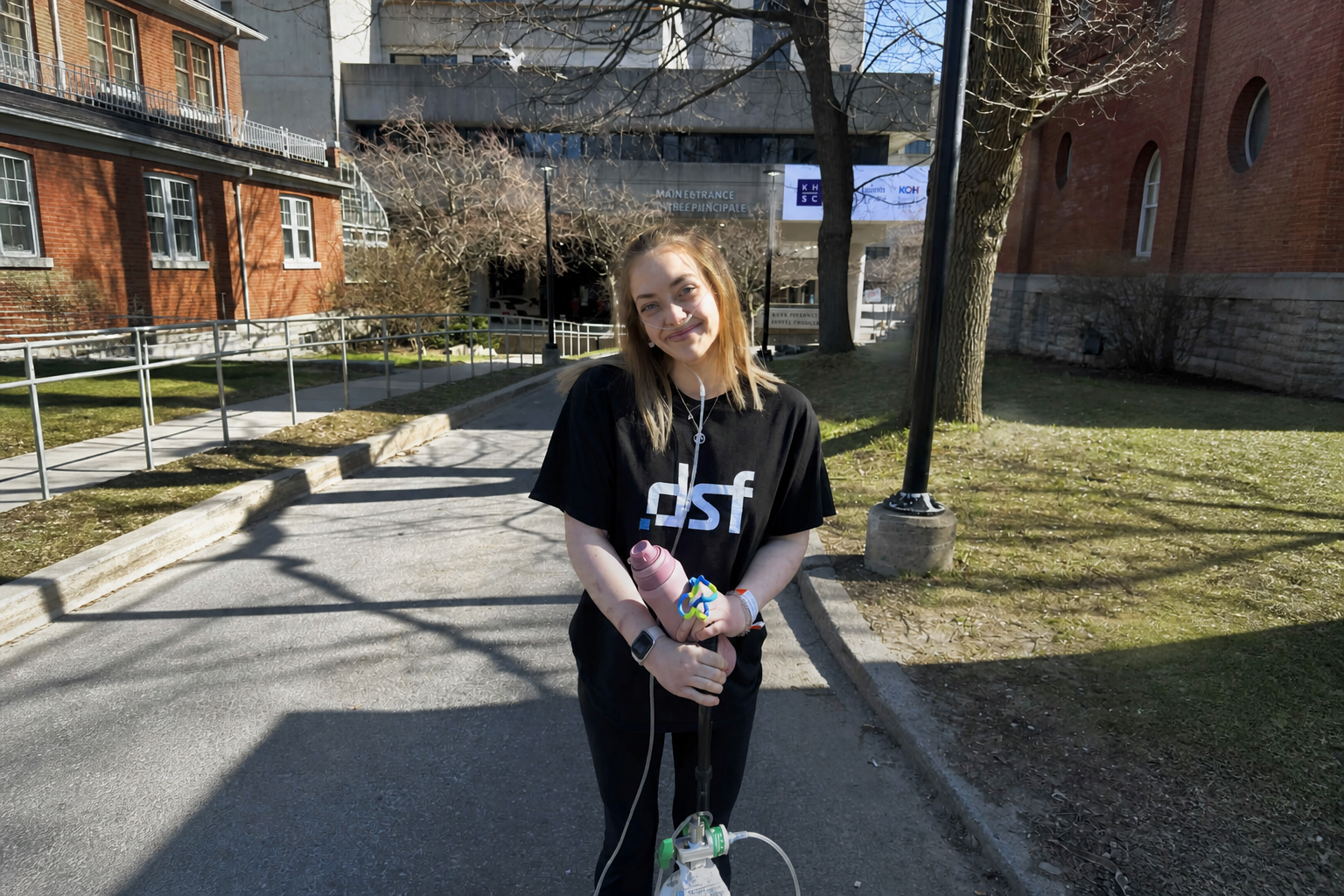
Les saines habitudes de vie avec la fibrose kystique: trouver un équilibre réaliste au quotidien
À 25 ans, Lex partage comment elle apprend à écouter son corps, à gérer son énergie et à trouver son propre équilibre avec la fibrose kystique, sans laisser la maladie définir qui elle est.
.jpg)
Aimer la vie et apprendre à la donner
Atteinte de fibrose kystique, Audrey refuse de se laisser définir par la maladie. Entre le deuil de son père, son combat pour la santé et son nouveau rôle de maman, découvrez le portrait d’une femme qui transforme chaque tempête en arc-en-ciel.