Testimonial: My anxiety management tools, special for CF
Amélie Payment shares her main tools for managing anxiety related to cystic fibrosis, by focusing on hope, personal goals, rejuvenating activities and gradual preparation for the major stages of care.
By Amélie Payment
For my second story in Living with Cystic Fibrosis magazine, I would especially like to try to help the many people with CF who suffer from anxiety by sharing my personal experience. My goals are to inspire you through my experiences, to allow you to make psychological and emotional connections between my life and yours and to give you tools to fight the scourge of anxiety. So I'm going to talk to you about the three main aspects that cause me the most anxiety on a daily basis and my tips for reducing it.
Set goals
Cystic fibrosis (CF) is a disease that requires time, structure, organization and autonomy. What
sometimes has the long-term effect of causing anxiety. I am now seventeen. On my birthday, the first thought that went through my head was, “Wow! I'm already celebrating my seventeenth birthday when I wasn't supposed to even have one. That's what I call a beautiful miracle.” It's proof that, sometimes, life plays heck of a trick on us and that despite what we may think, it's not always negative. As a child, I was hospitalized for the whole of my first year of life. I had twelve blood transfusions, had surgery, had a pulmonary hemorrhage, was in a coma for three months, had to live with a gastric tube for a few years and so on. Today, I go to the hospital every three months, eat normally and am doing relatively well. Do you see? There is always hope.
Having hope and goals is the first tool I can recommend to lower your anxiety levels. Busy thinking about setting goals and working hard to reach them distracts my mind and keeps me from worrying and imagining things that haven't happened yet.
What I also do sometimes is write down my goals. That way, when I end up deleting them from my bucket list, my motivation to achieve the next goal only increases.
Cystic fibrosis, an invisible disease
Unfortunately, cystic fibrosis (CF) is an invisible disease. Often when people find out that I am sick, they say, “Oh! Are you sick? However, it doesn't seem at all, you look in great shape! ” In life, my aim is not necessarily to get complaining. But even if I don't want to feel sorry for myself, that kind of line makes me a bit sad and I feel misunderstood during difficult times. I am not in a wheelchair, I am not “plugged into machines” and I am doing relatively well... according to the figures evaluating my lung functions. However, this does not mean that I am not a bit discouraged by my routine and by the fact that my whole life has been a series of deprivations. Having to monitor all my actions creates anxiety. The fact that some doctors or medical staff sometimes make comments like, “You know? You are not the worst! ”, it exhausts me. I then feel the need to justify myself when I am tired, sad or anxious. This kind of line makes me feel like I'm not being taken seriously, that I'm not “sick enough” to have the right to experience emotional lows. I believe that medical staff should under no circumstances make comparisons between different people with CF. Each person experiences the situation differently and sometimes, yes, we need to talk about it. Knowing that you have an incurable and degenerative disease is hard. Despite everything, we stay up and live our lives as if everything were normal. But yes, sometimes I need a day to rest when
I take antibiotics or do an activity I love to hang on to life and not completely
lose me.
So my second tool for managing anxiety is to do things I like, such as writing, reading, listening to a movie, walking, etc. To vary the activities so that they are not repetitive. Why does it work? Because getting out of my strict routine helps me to be more positive and calm.
The stress of being transferred to the adult hospital
Being transferred to the adult hospital is very stressful for me. And I know it is for a lot of you. I often ask myself, “What does that look like? Am I going to be completely alone? Will I be able to organize all my appointments? ” Leaving the medical staff I've known since I was born in Sainte-Justine and changing my habits to jump into a new world scares me. I feel like I'm leaving a family. I've always had the same doctors, nurses, respiratory therapists, respiratory therapists, front desk receptionist, gastroenterologist, social worker, dietitian, and allergist. They know me and have seen me evolve.
I confided in these people about my fears because, yes, it is a difficult step to overcome. Once I have passed it, I will be able to explain to you what the “adult hospital” is. At the moment, I am asking myself a lot of questions and am preparing myself as best I can to become completely independent.
So my third tool for reducing anxiety is to be prepared. Make an appointment with your social worker to visit the new hospital with you. In this way, the change will be less abrupt and you can begin to visualize this evolution to accept it. I truly believe that once I have visited the site and accepted this drastic change, my instinct to adapt as a child living with cystic fibrosis, which is already overdeveloped, will take over, and I am confident that everything will work out like a charm.
To finish on a positive note, cystic fibrosis is not easy, but it allowed me to grow as a young woman and to develop a strong sense of empathy. In my testimony, I talked about the three aspects that make me the most anxious in my daily life. I hope you were able to relate to it and felt a bit more understood.
Interviews and testimonies
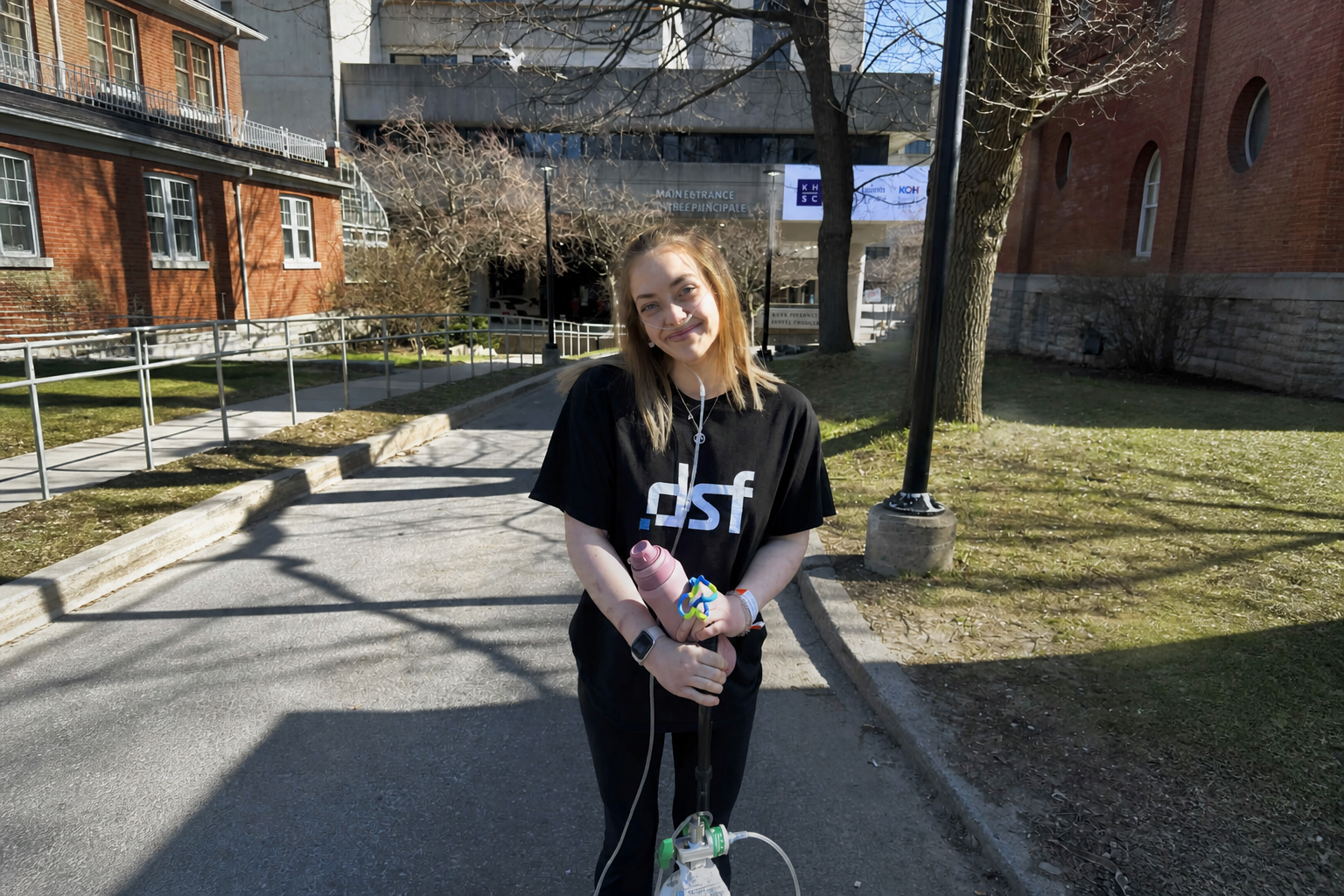
Les saines habitudes de vie avec la fibrose kystique: trouver un équilibre réaliste au quotidien
À 25 ans, Lex partage comment elle apprend à écouter son corps, à gérer son énergie et à trouver son propre équilibre avec la fibrose kystique, sans laisser la maladie définir qui elle est.
.jpg)
Aimer la vie et apprendre à la donner
Atteinte de fibrose kystique, Audrey refuse de se laisser définir par la maladie. Entre le deuil de son père, son combat pour la santé et son nouveau rôle de maman, découvrez le portrait d’une femme qui transforme chaque tempête en arc-en-ciel.