Testimonial: Having a sick child
A mother's testimony frankly describing the exhaustion, emotional rollercoasters, and lack of support experienced when caring for a child with cystic fibrosis.

Having a sick child is probably one of the biggest challenges you can face. It is necessarily an element that changes all areas of our life: family, couple, work, routine, etc. Living with cystic fibrosis on a daily basis means learning to juggle a lot of additional parameters. Even though being a parent is not always easy, being the parent of a girl with cystic fibrosis can push you to the limit.
There is obviously the shock of the diagnosis which starts a trying period, because there are a lot of things to digest and assimilate. However, looking back, I have the impression that it was a “small beer” compared to the other obstacles we had to face. Of course, each person experiences trials differently, not every family goes through the same difficulties. In our case, our daughter is combining challenges. In addition to cystic fibrosis, she has learning disabilities, an attention deficit disorder and other health problems... Let's say that at 14 months, the CF diagnosis was just the tip of the iceberg for us.
Of course, it's hard to see your child coughing, spitting, complaining. Having to type your little body for 20 minutes every day. Wondering whether to give them antibiotics, go to the emergency room, etc. Despite all this, in my opinion, the hardest part is not the physical symptoms, but the psychological difficulties. In addition to the ups and downs of this often unpredictable disease, you have to deal with the fluctuations in mood. Convincing your child to do their treatments when they have had a bad day or have just had a tear attack. When our child accumulates difficulties, the situation gets complicated. We must constantly adjust, review our routine, our strategies, our priorities.
To top it all off, cystic fibrosis is an invisible disease, meaning that for others (sometimes even the immediate family), it is easy to forget. Most people misunderstand what it really means on a daily basis and tend to trivialize its impact in our lives. Sometimes we were told that our daughter's health looked good even though her FEV1 (maximum exhalation volume in one second) had been in free fall for several months, or even that hospitalization was planned a few days later. In these conditions, it is sometimes difficult to find a listening ear to listen to us, to understand us. We can easily feel inadequate, because we are told that we talk about it too much, when we are just talking about our daily lives.
So for me, managing the “physical” portion of the disease, while difficult, is still less difficult than juggling all the other aspects. Our child's illness, whether we like it or not, interferes in all areas of our lives. How many jobs did I leave because balancing work, family and health was not possible, or simply because the bosses clearly lacked empathy. Managing your own emotions is one thing, but supporting your child through this ordeal is another! Parenting isn't the easiest job at first, especially since there's no real diploma. And with this kind of additional component, it can quickly become out of our area of expertise.
All in all, the medical care of our daughter is well provided by the clinics. When it comes to physical symptoms, FEV1, everything is relatively well. The disease is taken care of, but not our child and not us. As soon as you get over the physical aspect, it becomes risky. Needless to say, every professional does a great job, but they don't have the resources to really help us. Despite all their good will, unfortunately, their help stops there. Personally, I learned it the hard way. Asking for help and talking about how you really feel can easily backfire.
Between 2018 and 2020, we really went through a difficult period. Our 10-year-old daughter was in the midst of a period of opposition turmoil. It was a war morning and night for treatments. Despite poor school results, homework was often avoided. Convincing her to do her treatments was already an achievement and very often, the evening passed by. And good humor too. And the vicious circle sets in, one hand caught in the cog. We have consulted a lot of stakeholders since our daughter's 5 years: psychologists, neuropsychologist, psychoeducator, occupational therapist, social workers, etc. All seemed to have the same vision: everything is fine, it will pass. At the end of 2019, during a clinic appointment, we repeated our request for help, explained our exhaustion, our inability to convince her to do her treatments properly. We were offered a motivational calendar. I tried to list all the types of calendars we had already created. We wanted concrete help, like a physiotherapist who comes to the house sometimes a week, for a few weeks, to get some rest. We were sold the idea of the motivational calendar again! It was one too many. I said I didn't want to hear about their “damn” calendar anymore. We were taken to the side to tell us that our daughter's FEV1 kept falling and that if we didn't turn the tide quickly, they would be forced to report it to the DYP. According to them, we were responsible for our daughter's poor health. I froze, unable to defend myself. The words did not come out. Unable to believe this speech. Saying these words to us, the doctor was crying and I then understood that they had an obligation to warn us. That, in fact, they have no resources to offer us.
At the beginning of 2020, our daughter had sinus surgery and the hypothesis that Pseudomonas had lodged in her sinuses and not in her lungs was then confirmed. Two months later, she finally stopped using nebulized antibiotics that she had had to take twice a day since 2016. At least forty minutes saved every day to live your teenage life. At the same time, we discovered that she had sleep apnea and in the fall of 2020 she had her tonsils removed. These two operations changed our lives. She sleeps better and is therefore much less irritable and more focused at school. She regained confidence in her abilities. She has more time for herself, and is therefore more likely to do the treatments she has left. In the end, the symptoms at the time, which were mostly psychological, had everything to do with his illness, his physical condition.
The disease is not a combination of symptoms, certainly not a chronic degenerative disease like cystic fibrosis. Learning to live with CF, to “accept” it, for a growing child who already has to deal with a lot of emotions and hormones, is almost impossible to do without a hitch. We often hear that learning a diagnosis is a bit like grieving, with the five “regulatory” steps. Surely you know them: denial, anger, negotiation, depression, and acceptance. But it is only a theory because, in practice, I doubt that this is how it goes. In fact, one of my daughter's pulmonologists already used this ready-made formula for me: according to him, we were stuck in the anger phase, and for this reason, our daughter's health was not improving. If we follow this logic, as a parent, we no longer have the right to be upset in the hospital, otherwise we are pigeonholed as a parent who does not accept his child's illness. And you know as well as I do that with our health system, upset is often an understatement!
From experience, I believe that, although these famous five steps are quite true, it is the idea of phases that does not make sense. As if it had to be a logical continuation that necessarily leads to the final stage: “acceptance”! In my opinion, these are emotions that we experience in disorder, without logic and especially without purpose. This is even more true when it comes to a chronic condition such as CF, which comes with its own set of additional diagnoses. It is not a linear condition, but rather a physical and emotional roller coaster. Also, the whole family experiences these emotions at a different pace, where other emotions, such as misunderstanding and disappointment, are added. Sometimes, like it or not, it can take us back a phase or two. Seeing your child angry at his illness, hearing him say: “It's unfair, why is this happening to me and not to someone else”, even if you already thought you had “accepted” CF, it doesn't take more to make us plunge into this anger again too.
I always write “accept” in quotation marks, because although we often hear this expression, I admit that I don't like it, I don't believe it. I am not an expert, I do not have a degree in psychology. On the other hand, in my experience, aiming for acceptance as the ultimate goal is more harmful than anything else. For me, “acceptance” is more about understanding that we are passengers on this roller coaster, for better or for worse. Recognize that we have already passed several “lows” and hope to stay on the upward slope for a long time while knowing that the low could return more quickly than you think. Hopefully, with time and a lot of effort, we will go up the next hill more easily. The important thing is to allow yourself to experience all these emotions, to welcome them and to try to understand them. This will make it easier to discern and cross them during the next descent. And above all, do not forget that despite bad experiences, exposing our vulnerability in order to find help is sometimes necessary. This is a real proof of courage.

Mother of two daughters, including Axelle, 13, FK.
Co-founder of Tousse Ensemble in 2013
Administrator for Living with Cystic Fibrosis since 2021
Interviews and testimonies
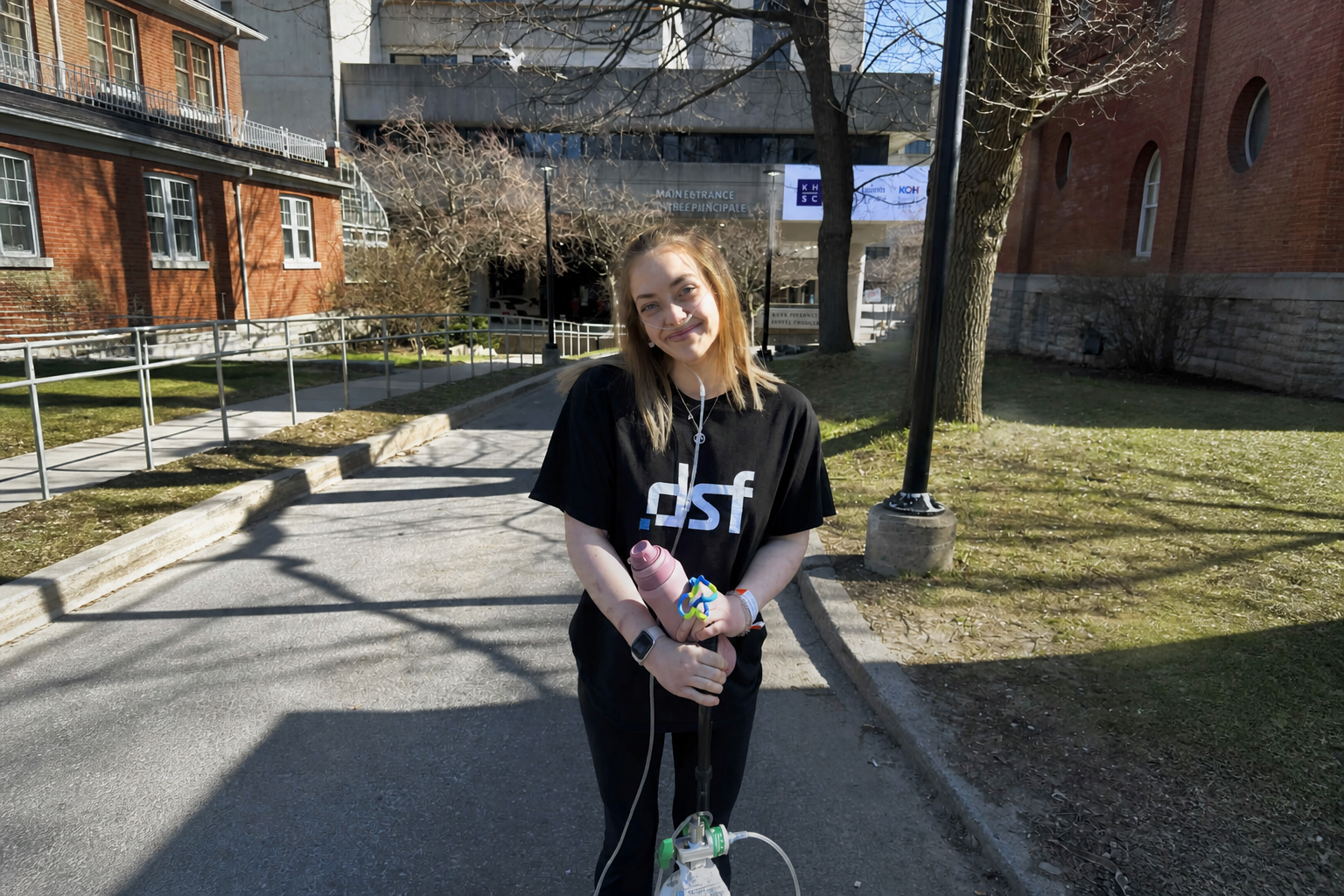
Les saines habitudes de vie avec la fibrose kystique: trouver un équilibre réaliste au quotidien
À 25 ans, Lex partage comment elle apprend à écouter son corps, à gérer son énergie et à trouver son propre équilibre avec la fibrose kystique, sans laisser la maladie définir qui elle est.
.jpg)
Aimer la vie et apprendre à la donner
Atteinte de fibrose kystique, Audrey refuse de se laisser définir par la maladie. Entre le deuil de son père, son combat pour la santé et son nouveau rôle de maman, découvrez le portrait d’une femme qui transforme chaque tempête en arc-en-ciel.