Testimonial: Diagnosed in adulthood, an unknown cystic fibrosis
Diagnosed at 58 after a life marked by unexplained symptoms, Claire testifies to atypical cystic fibrosis, diagnostic error and the importance of raising awareness about this little-known form of the disease.
Was I surprised? Yes and no.
Yes, because I was always there, relatively fit, unwittingly defying the statistics, leading an active and full life, despite the frequent mood swings of a health that was too often lacking for my taste. Yes, because in 58 years of life, I had nevertheless consulted competent pneumologists and other specialists I trusted. So, if I had cystic fibrosis, one of them, one of them, would have “turned on”, right?
No, I wasn't really surprised because everything was finally explained:
- I have always been salty like an anchovy at the least exposure to the sun, at the least physical effort;
- I had “liver attacks” from very early childhood, our old family doctor prescribing a diet that was as severe as it was incomprehensible: without fat, without salt, without milk, without sugar and especially without taste, at FOUR YEARS!
- My whole existence was punctuated, in an ascendant fashion, by a succession of coughs, colds, flu, sinusitis, bronchitis, asthma attacks, recurrent pneumonias; bronchiectasis then appeared with their series of pulmonary superinfections: with aspergillus, with intracellular avium (a mycobacterium), with staphylococcus aureus, with pseudomonas aeruginosa, with their series of pulmonary superinfections: with aspergillus, with avium intracellulare (a mycobacterium), with staphylococcus aureus, with pseudomonas aeruginosa, with mucositis, with pseudomonas, a powerful cocktail of critters that earned me several memorable hospital stays;
- A severe episode of hemoptysis, which occurred in my early 20s, left me with scar tissue in my lungs that was interpreted retrospectively — and clearly incorrectly — as tuberculosis;
- A maternal aunt died at the age of 14, allegedly of tuberculosis: at least that is what was believed until very recently;
- An unexplained colon cancer changed my life eight years ago, requiring two surgeries and six months of chemotherapy. Why unexplainable? Because there were no cases of cancer in my extended family, because I had been eating well for ages, that I was active assiduously, and that I had a healthy lifestyle. What do you mean colon cancer?
The cat comes out of the bag
In 2005, I started a pulmonary rehabilitation program at the Montreal Chest Institute. It is a multidisciplinary physical activity education and training program that is primarily aimed at people with COPD. It is run by a magnificent team of health professionals, generous and dedicated, who manage it at arm's length with the resources at hand, a “hell of a good gang”, I tell you. I had to insist on my pulmonary specialist (attached to another hospital) to refer me there: in his opinion, I did not have the required profile.
This program, I say loud and clear and without hesitation, brought me back to life. I am particularly grateful to Anne, the physiotherapist on the team who oversees physical activity rehabilitation: observing my reactions to the effort, asking me about my family history, she was the one who offered me to take the sweat test and took the steps to do so. And that's how the diagnosis came in.
What do you mean cystic fibrosis?
“Now that I have CF” [i]
Sorry for the English subtitle, but this is the name of an American work that was then given to me and of which unfortunately there is no French version (free translation: Now that I have fibrosis cystic). The publication is aimed specifically at people diagnosed in adulthood, with a so-called atypical form of the disease (“non-classic”, we read in the book). Known cases constitute approximately 10% of the total population suffering from cystic fibrosis, and have some particular characteristics (see the text opposite).
You had never heard of it? Don't worry, you're not the only ones: the numerous doctors, pneumologists, ENT specialists and other specialists consulted in my life either, it seems. However, I am deeply convinced that there are many people in the population who are affected by cystic fibrosis and who are unaware of it. At the very least, this raises a number of questions:
- How well is the atypical form of cystic fibrosis known to the medical profession? Is this subject addressed during the university training of future doctors?
- Does the scientific literature deal with this question? Is it discussed during specialized symposiums or congresses?
- Is there specific data on the status of the case in Quebec and Canada? On the incidence of gastrointestinal cancers in affected people?
- What can be done to remedy a late diagnosis of this disease? Wouldn't a neonatal screening program, like there are elsewhere, be desirable?
- How can we remedy the absence of documentation in French on the subject, or even the absence of information from the general public?
Living well, cystic fibrosis or not...
I am 61 years old. I have had cystic fibrosis since birth and have only known it for three years. What have I done since the diagnosis? Quickly recovering from my emotions, I had my medical file transferred to the Chest Institute. I have documented the disease. I started medical treatments adapted to my condition. I exercise regularly and when I don't exercise, believe me, I pay a lot of money for it. I practice respecting the newly identified boundaries every day even though I “hate” that, the limits. I take on fewer crazy projects but I pursue with the same passion those that are within my reach. I take care of the people I love as best I can and believe me, they make me feel good, even if they are sometimes tiring. And then, I joined the great CPAFK team and it makes me feel good, despite the “time difference”, if you know what I mean. However, I would be delighted to see people diagnosed like me in adulthood arrive at our meetings and therefore, undoubtedly suffering from the atypical form of the disease.
Sometimes I hear people my age and even much younger, in good health, complaining about the passage of time and the aging that comes with it. The fear of aging is a concept that I don't understand. You either get old or you die. Since there is no third way, getting older is fucking good news, right? END 15-12-08
Claire Boulerice's testimony
Montreal (Quebec)
[i] Stern, Robert C., Eileen Widerman, Barbara Palys, and John R. Palys, Now that I have CF/Information for men and women diagnosed as adults, Solvay Pharmaceuticals, 2004, 184 pp.
Interviews and testimonies
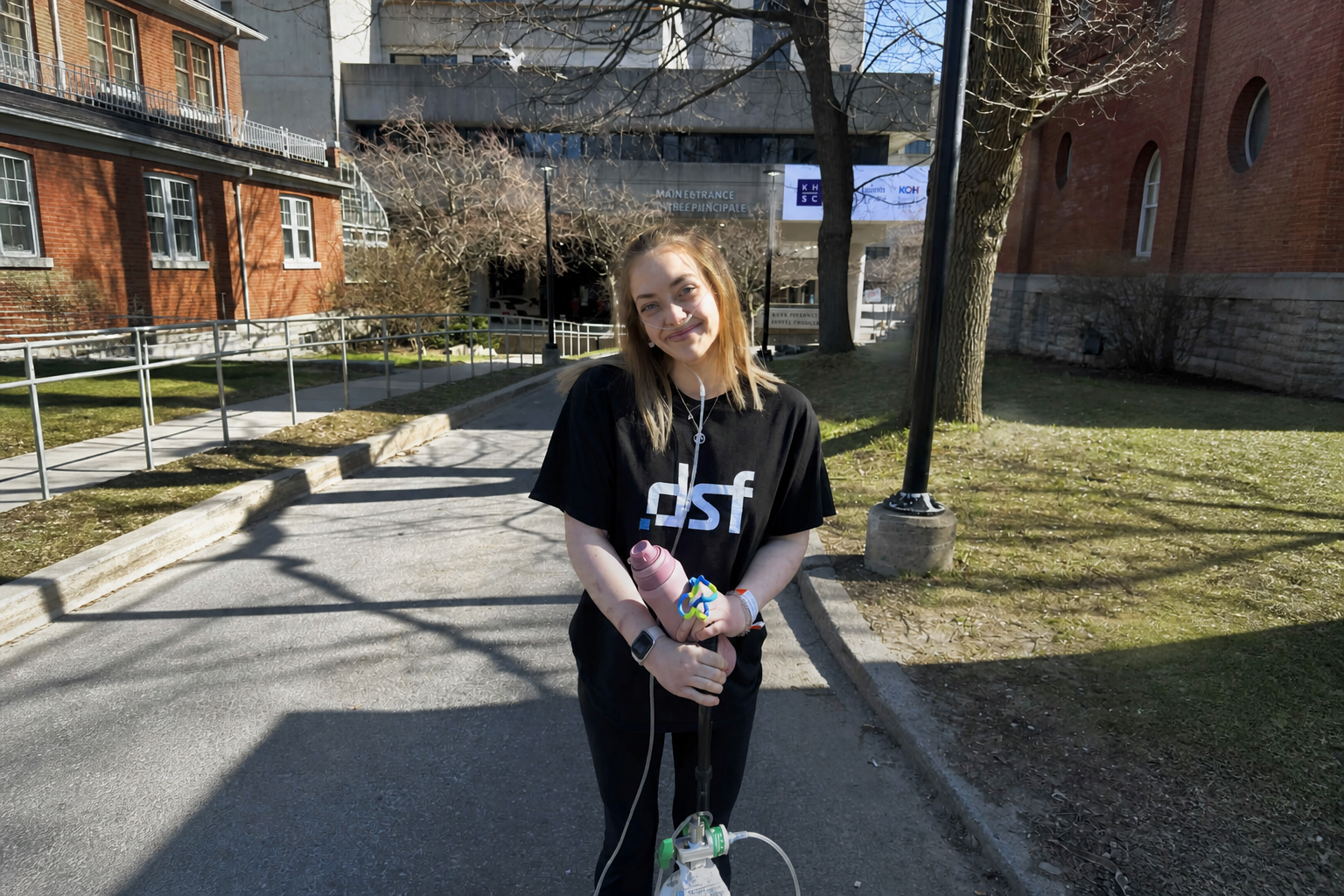
Les saines habitudes de vie avec la fibrose kystique: trouver un équilibre réaliste au quotidien
À 25 ans, Lex partage comment elle apprend à écouter son corps, à gérer son énergie et à trouver son propre équilibre avec la fibrose kystique, sans laisser la maladie définir qui elle est.
.jpg)
Aimer la vie et apprendre à la donner
Atteinte de fibrose kystique, Audrey refuse de se laisser définir par la maladie. Entre le deuil de son père, son combat pour la santé et son nouveau rôle de maman, découvrez le portrait d’une femme qui transforme chaque tempête en arc-en-ciel.