
Profile of the CF population in Quebec
Quebec study drawing up a current socio-demographic portrait of people living with cystic fibrosis in order to better adapt services and defend their rights.
Study led by Sébastien Puli on behalf of the organization Living with Cystic Fibrosis
To date, no recent study provides information on the sociodemographic profile of the fibrocystic population in Quebec. The last study of this kind dates from 2006, more than 15 years ago.
A lot has changed since then, in particular societal and economic issues, knowledge of the disease and its management. That's why Living with Cystic Fibrosis, which has been working for and by people with CF since 1985, decided to look into the issue.
In order to identify and understand the issues experienced by people with CF and their loved ones, to defend their rights and interests and to better guide our services, we decided to conduct a vast survey among adults and parents of children living with cystic fibrosis in Quebec.
OBJECTIVES
1- Know the profile of the CF population in Quebec.
2- Adapt our service offer according to the realities and needs of people living with cystic fibrosis in Quebec.
3- Collect data that will allow us to carry out further studies later.
METHODOLOGY
- Step 1: Create the questionnaire
Several meetings were held with various representatives of the CF community in order to design a questionnaire that covers most of the data necessary for our goals.
- Step 2: Administering the questionnaire
The questionnaire was published online. We reached our participants via our social networks, emails and posters posted in the various FK clinics in Quebec.
- Step 3: Data compilation and exploitation
After collecting the data, they were retrieved in their raw format, then dissected and analyzed in order to create a file usable by our organization.
RESULTS
The compilation of data reveals several problems.
Economic fragility
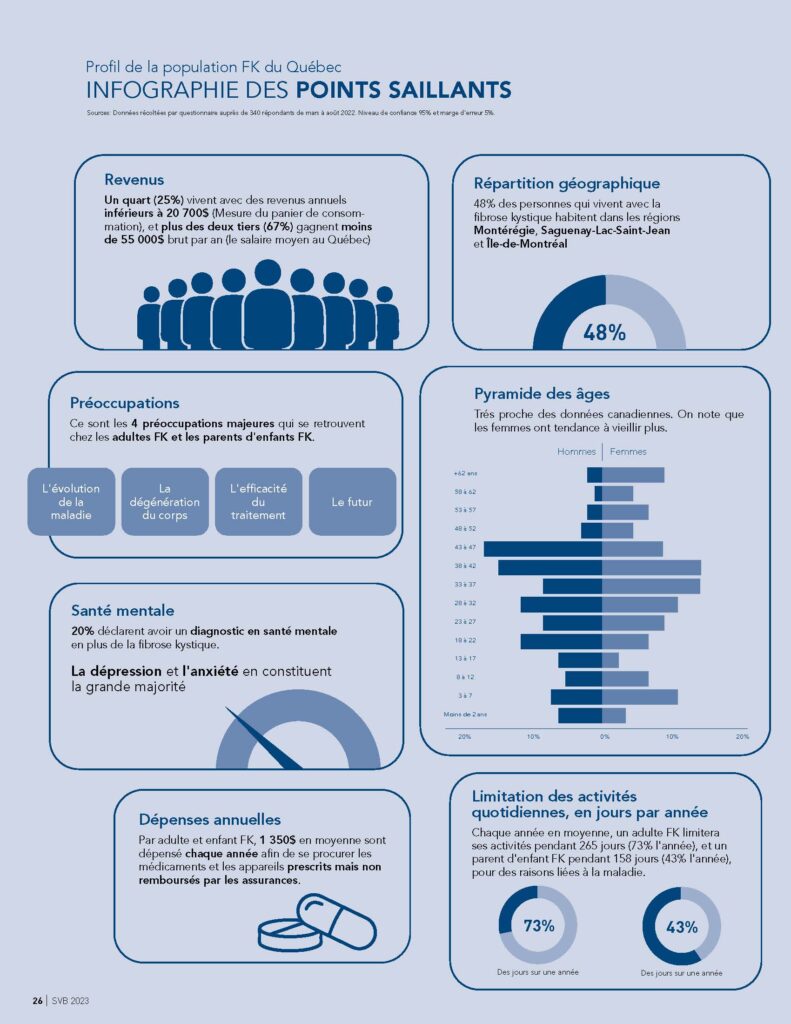
Adults living with cystic fibrosis are a population that can be considered economically fragile. In fact, two-thirds of them have incomes below the average income in Quebec, and a quarter below the GPA (measure of the consumer basket). Moreover, only about half work full time. The difficulties of accessing a job for many of them are a major challenge.
Drug and device coverage
For the vast majority of households where a member has CF (adult or child), medications and devices prescribed by a doctor are not reimbursed, which represents a considerable cost each year. This situation is in addition to the economic problems already mentioned. That some people simply cannot afford the necessary medications and devices due to their costs is very worrying.
Daily impact of the disease
Cystic fibrosis has considerable daily consequences for adults, but also for parents. The number of days per year where daily activities must be restricted for reasons related to illness is half the year for parents and three-quarters of the year for adults. The mental health consequences of this situation should not be overlooked.
Parents' concerns
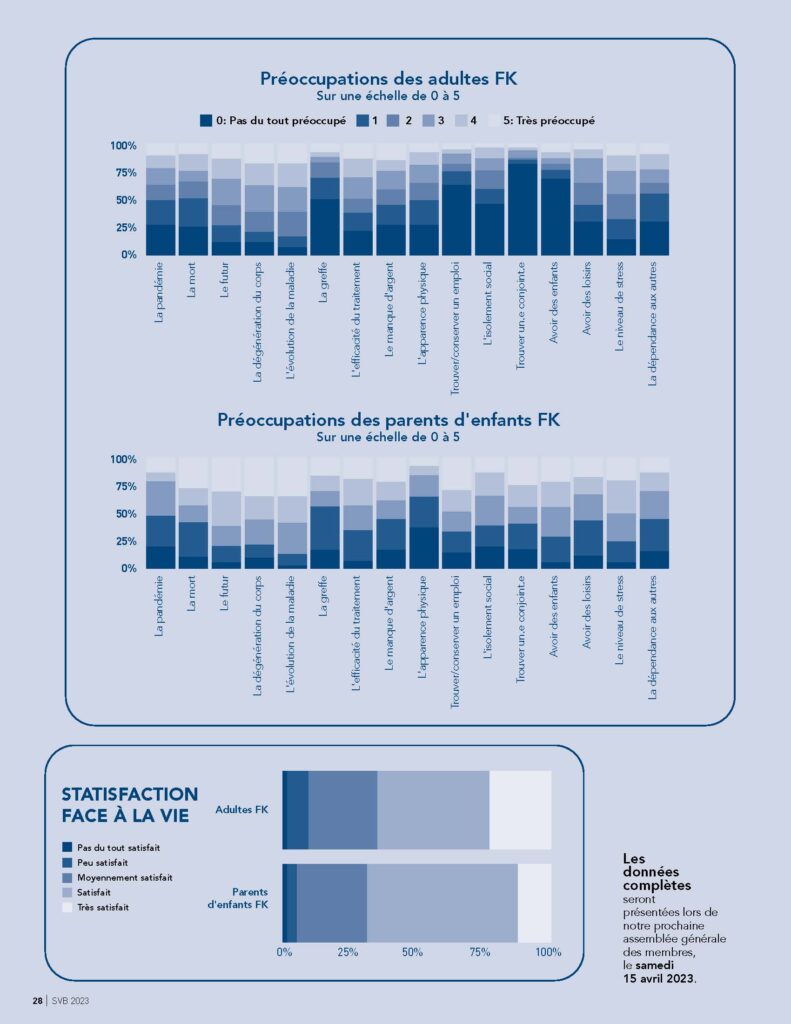
When comparing the levels of concern between adults with CF and parents of children with CF, we notice that the parents of children with CF have a much higher level of concern. Although some concerns are the same in both categories, it should be noted that parents worry much more than adults about matters of daily life. It would be interesting to push the analyses and reflections further, but also to take into account the possible need for information and support among them.
Mental health
The psychological health of people living with cystic fibrosis is an increasingly noticeable issue. According to the data, just over 20% of them were diagnosed with a mental disorder, mainly depression and anxiety. In addition, there are those who do not have a diagnosis, but for whom these challenges are also present.
Geographic disparity
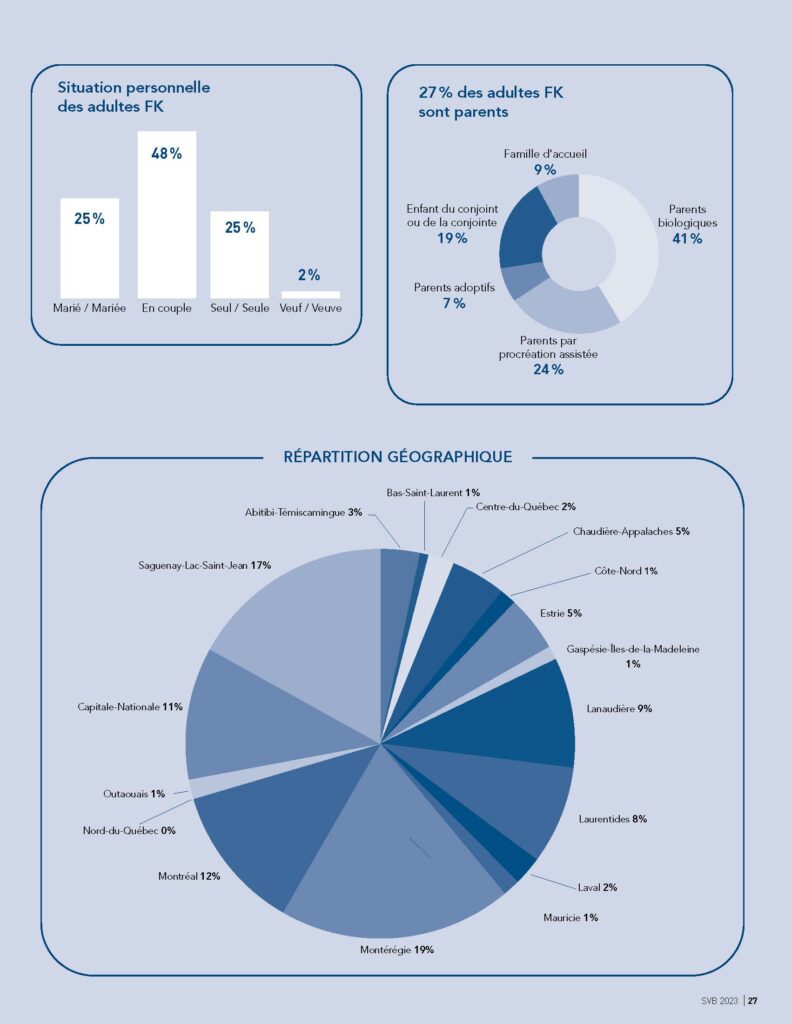
The geographic distribution of people living with cystic fibrosis shows that nearly half of them are grouped into three administrative regions: Montérégie, Montreal and Saguenay—Lac-Saint-Jean. While the first two regions are traditionally more populated, the third is a specific feature. It would be interesting to carry out a study on the management of the disease in the different regions, and to see if there are disparities. It is also important not to forget those from other regions, because even if there are fewer of them, they are present in all regions of Quebec.
Retirement
We were able to note in the responses that there are more and more CF retirees, which was not the case in the past. Several reported a lack of support and information about their reality.
This data will allow our organization to adapt its services and to better know the community and thus better represent people living with cystic fibrosis in institutions.
They are also a good starting point for further studies on specific issues, as our raw data can be cross-referenced in order to bring out specific figures on a given situation.
Research


Antibiotic resistance and Pseudomonas virulence: two sides of the same coin
In people with cystic fibrosis, some resistance to antibiotics caused by Pseudomonas aeruginosa may paradoxically increase bacterial virulence, complicating lung infections and opening the way to new therapeutic approaches.