Testimonial: The promise of a future
A powerful testimony about waiting for a transplant, the loneliness of the disease and the hope regained thanks to medical advances and organ donation.
I have always been a very active person. I have always lived life to the fullest, with an overwhelming sense of optimism. I have played many sports as an amateur, knowing my limits well, but with a constant desire to surpass myself. For me, moving and sweating were integral to how I took care of my health.
At 25, I was living a practically normal life: a spouse, an apartment, studies, a job, daily sports, an active social life. Then, over time, the disease left its mark. In January 2010, at the age of 30, a virus overwhelmed me for several weeks. That was when I realized that I would have to follow the same path as many people with cystic fibrosis: that of the transplant.
The seesaw
My health condition was rapidly deteriorating and discussions with my pneumologists at the Hôtel-Dieu in Montreal became more and more serious. Being followed by the same professionals for years creates strong relationships. This period was marked by a lot of tears, frustrations and disappointments, often in their offices. I thought I was invincible. I thought I was stronger than the disease. But cystic fibrosis knew exactly how to call me to order.
Talking about a transplant means something terrible and paradoxical at the same time: the body is still strong enough to withstand two years of intensive treatments, but not strong enough to live beyond that. Two sides of the same coin. This reality completely changes the perspective of life.
In just a few months, I had to quit my job. Finances followed the same path as my health. Plans for babies, homes, and career advancement fell apart. While my friends were building their future, I put mine on hold, not knowing if it would ever resume.
The loneliness of illness
I did not want to impose this medical life on my spouse. Between home and the hospital, I felt like I was becoming a burden. After seven years of being in a relationship, we split up. This break has left profound marks. My social life fell apart and I lost several friends to whom I thought I could confide my fears.
Every patient knows it: you are always alone with your illness. No one can really understand what it means, physically and psychologically, to fight for survival for nearly two years every day. It's a constant fight. As Dédé Fortin said so well: “Life is short, but it's long in the small bits.”
The wait
The wait for a transplant is endless. Every day, the same question comes up: is the page going to ring today? Hospitalizations have increased. Every two to three months I was given intravenous antibiotics to stabilize my condition. At the hospital, I often walked the corridors alone, overwhelmed by a sense of isolation. I felt like I was on the fringes of my generation.
Oxygen-dependent, I moved around with my nasal cannula, meeting glances heavy with judgment or pity. “He is so young to be sick”, I heard often. However, there is no age limit for the disease. She strikes without warning.
Luckily my family and a few friends stayed there. Between the ups and the downs, I held on to the little moments of happiness and hope.
The strength of the bond
The hospitalizations were all the same, but each brought its own set of new challenges. During this period, I built very strong relationships with other people living the same reality. For the first time, I was sharing my fears with people who really understood. We were all asking ourselves the same questions: will we be strong enough to wait for the transplant? Is death the only way out?
What united us all was hope. The call. Some are still waiting today. As for me, I was fortunate to receive two healthy lungs and a healthy liver. An invaluable opportunity that I intend to honor, on behalf of the person who made this donation and those who are still waiting.
Where do I come from
I don't forget the fight my mother fought. During our childhood, no treatment was ever missed. At the time, there were no clinics for adults with cystic fibrosis. For her, that meant one thing: her children would not survive to adulthood. Over time, the arrival of specialized clinics and multidisciplinary teams has brought hope.
As a teenager, at the age of fifteen, I was wondering what I would do with my life, knowing that the predicted life expectancy was then 25 years. What is the point of planning for the future when an expiration date seems already in place? However, this date has faded over the years.
Today
Thanks to medical advances and transplant programs, the future is now possible for people with cystic fibrosis. The transplant saved my life. It allowed me to envision a future and to reach dreams that I thought were unattainable.
Today, at the age of 33, I am once again standing, symbolically, in the center of my high school courtyard. But this time with no expiration date. My future is in front of me. And it's up to me to take advantage of it.
Testimonial by Alexandre Grégoire
Montreal
Interviews and testimonies
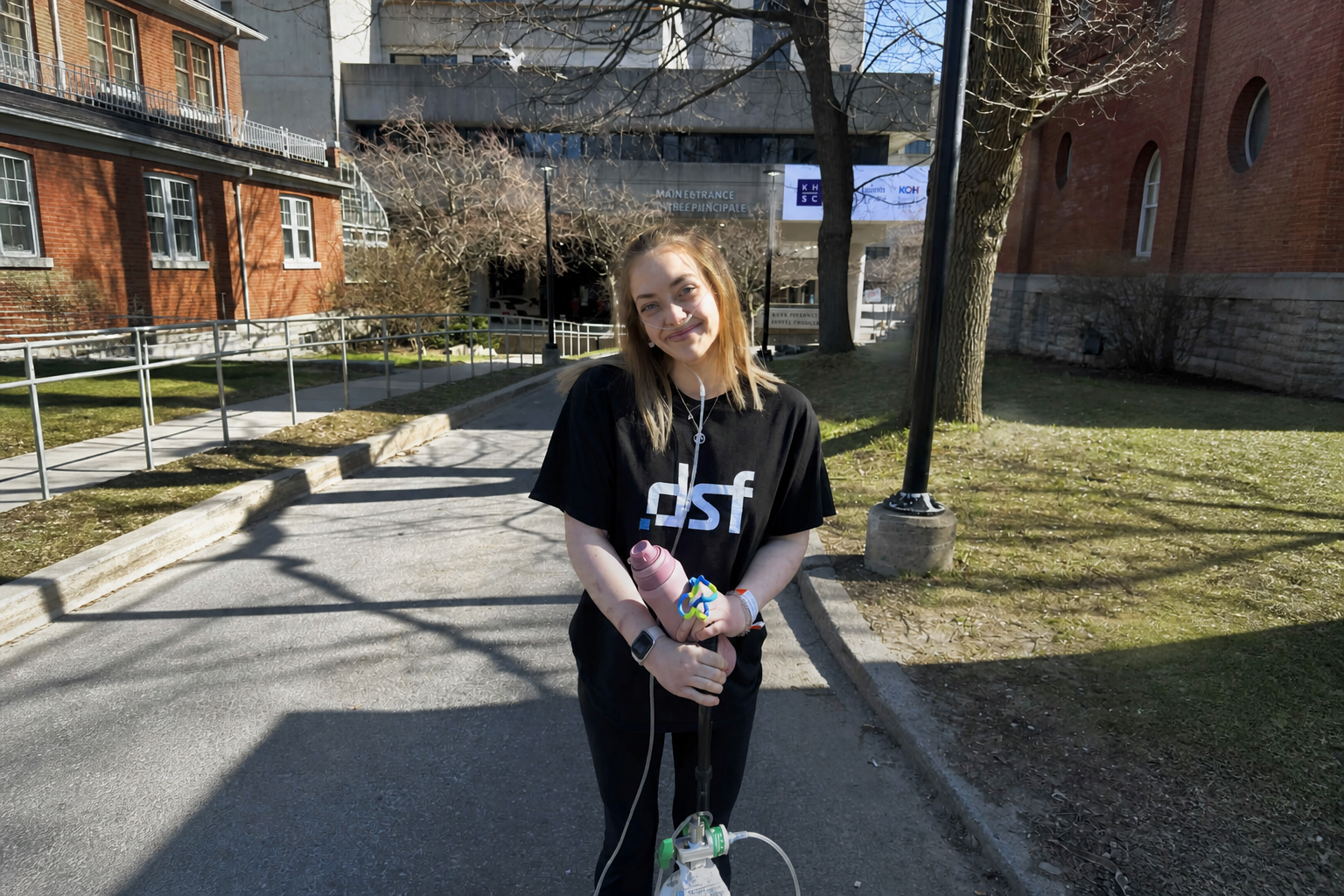
Les saines habitudes de vie avec la fibrose kystique: trouver un équilibre réaliste au quotidien
À 25 ans, Lex partage comment elle apprend à écouter son corps, à gérer son énergie et à trouver son propre équilibre avec la fibrose kystique, sans laisser la maladie définir qui elle est.
.jpg)
Aimer la vie et apprendre à la donner
Atteinte de fibrose kystique, Audrey refuse de se laisser définir par la maladie. Entre le deuil de son père, son combat pour la santé et son nouveau rôle de maman, découvrez le portrait d’une femme qui transforme chaque tempête en arc-en-ciel.